Monday, February 6, 2017

Judges and Legislators


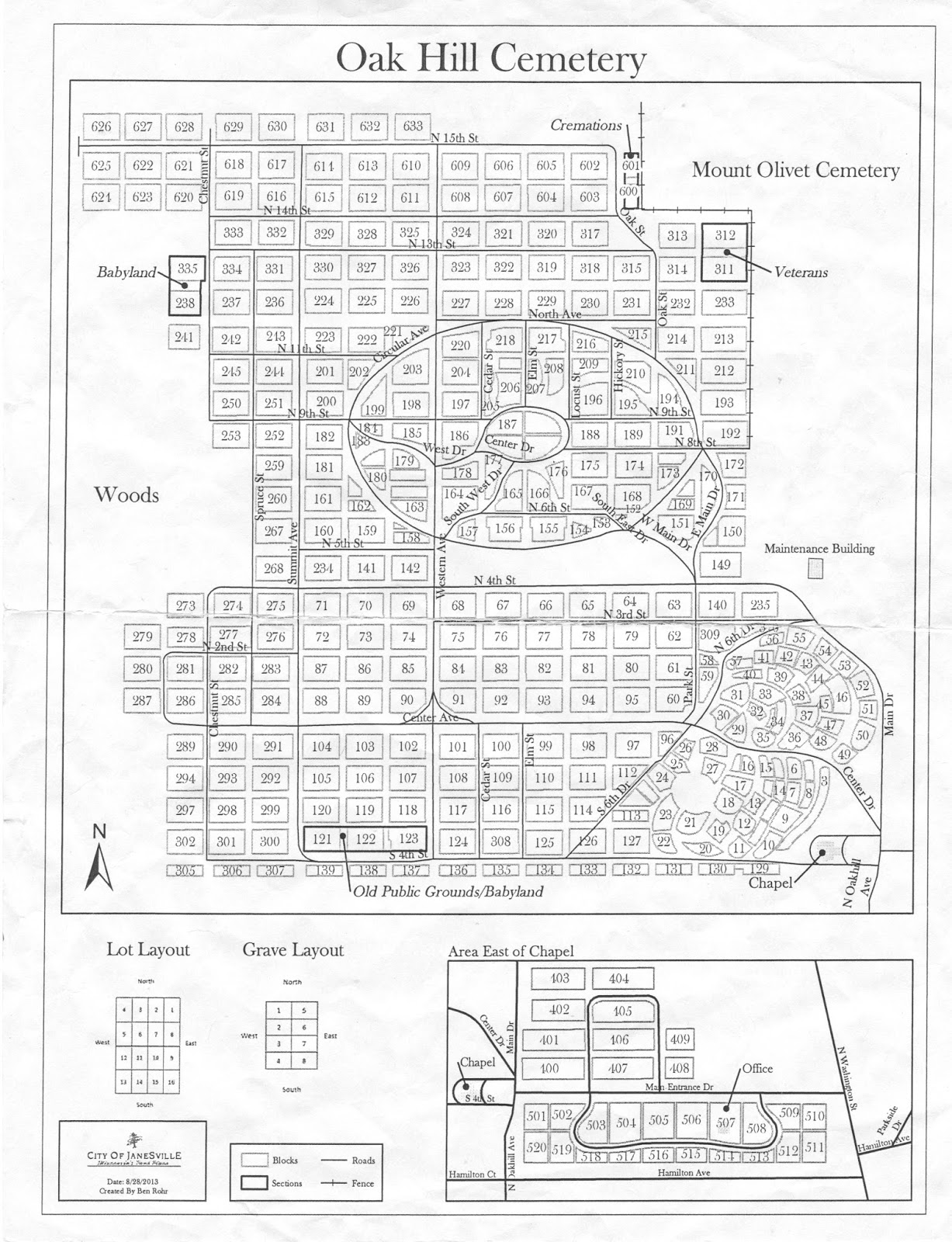
Oak Hill Cemetery features monuments to a number of men who helped shape the laws of both Wisconsin and the USA, and who served as respected judges.  I got the idea from a chapter from Maurice Montgomery's self-published book, Memory Walks in Oak Hill Cemetery, and some of the biographical information.  A few of the people on this walk were not in his book, and information comes from both published histories and information published in the Janesville Gazette.  You should be able to locate all the graves if you either get a map from the cemetery office (Monday - Friday 10 A.M. until 1 P.M.) or see previous blog entries and run off a copy for yourself.

1.  Ithamar Conkey Sloan (block 6, hillside vault)

People are curious about the sealed hillside vault near the chapel.  Sloan constructed the vault for his entire family - about a dozen people. Originally the vault was faced with marble and featured the family name, but only the core and sod roof remain today.

Despite his odd name, Sloan was a highly respected man, Born in Madison County, New York state, he studied law and was admitted to the bar in 1848.  Six years later he came to Janesville, where in 1858 and 1860 he was elected District Attorney for Rock County.  In both 1862 and 1864 he was elected to the United States House of Representatives, where he served on committees dealing with public lands and war expenses.  When Lincoln was assassinated, Sloan represented Wisconsin at the President's funeral.

After the Civil War ended he returned to Janesville and practiced law.  In 1875 he moved to Madison and became the Assistant Attorney General for the State of Wisconsin, under his brother, Andrew Scott Sloan, who was Attorney General for the state. One of his last acts as Wisconsin's Assistant Attorney General was to present the petition of Lavinia Goodell, fellow Janesville lawyer and friend, to appear before the Wisconsin Supreme Court. Although Miss Goodell's petition was denied by the supreme court, later Wisconsin law was rewritten to allow any qualified person - including a woman - to practice before that court.  Later Sloan was Dean of the law school at the University of Wisconsin.

2.  Edward Vernon Whiton (block 35)

Edward Whiton was born and educated in Massachusetts, and studied the law there as well. As a young man in his thirties he came west and settled down in a cabin east of Janesville, and became a lawyer here.  In 1847 he married Amoret Dimock, a woman whose brother Edward had ties to the Tallman family.  E.V. Whiton was involved in Wisconsin Territorial government, working on statutes for governing the territory, and serving as a member of the territorial legislature.  When the state government was organized Edward Whiton was elected judge of the 1st circuit, which included Rock County, and that also made him a justice of the Wisconsin state court.

When the Wisconsin Supreme Court was organized in 1853, Whiton was elected Chief Justice, and served until his early death in 1859.  Whiton, who was widely admired, had a part in a number of important cases.  One was connected to the Fugitive Slave Act, which held that all cases involving runaway slaves were automatically federal cases, and had a special commission whose duty it was to return such slaves to their southern owners.  Joshua Glover was a black man owned by  B.S. Garland, a Missouri slave owner.  In 1854 Glover was captured and jailed in Milwaukee, but when federal officials attempted to return him to to Mr. Garland, angry Wisconsinites surrounded the jail, attacked it with shovels, pick axes and other implements, and released Mr. Glover, rushing him to Racine.  Several people were arrested in this incident, including Sherman Booth, a Milwaukee newspaper editor, who was convicted of violating the Fugitive Slave Law.  The case was appealed to the Wisconsin Supreme Court. Judge Edward Whiton wrote an opinion that the Fugitive Slave Act was wrong, because  it attempted to give federal commissioners judicial powers, and because that denied accused fugitives the right to trial by jury. 


3.  Harmon Sweatland Conger (block 92)

You are looking for a draped and tasseled marble block not far from the road the runs up the right side of the chapel, up quite near the Tallman plot.

H.S. Conger was born in Cortland County, New York, in 1816.  He grew up on the family farm and attended a local academy before studying law in the office of Horatio Ballard.  Conger was admitted to the bar of New York, and worked at the Court of Common Pleas and the Supreme Court of New York at Utica.  While he was still studying law he purchased a local newspaper, The Cortland County Whig, in which he editorialized in favor of Henry Clay for President in 1841. In 1847 he was elected to the United States House of Representatives.

Conger married Lucy Canfield, who was six years younger than he was, in 1845. They moved to Janesville where she died in 1861. Several years later he married a second time, this time to Mary Adelaide Atkinson.

By 1870 he was elected circuit judge of the newly created 12th Circuit Court.  It was during that time that Lavinia Goodell applied for admission to practice law, and seeing no reason why she should not be permitted to do so, he admitted her to local practice.

In the last few years of his life Conger was painfully afflicted with rheumatism, and  he found no medicine that gave him relief.  He died at home in Janesville in 1882, and his obituary in the Janesville Gazette was very complimentary saying ...(H)e gave the country more than a quarter century of the best efforts of his life. His friends can say that there is no stain of dishonor upon it, or deed which will throw back a shadow.

4.  Otis West Norton (block 91)

 Otis West Norton, a New York state native son, was father of Mrs. Edgar Tallman and his gray granite family monument is very near that of the Tallman family.  His obituary, which ran in the Janesville Gazette in 1889, does a good job of summarizing some of his accomplishments.

DEATH OF HON. OTIS W. NORTON

Rock County's Representative in the Earliest Wisconsin Legislatures

The End Comes at Three O'clock This Morning After Prolonged Illness

The life of one of the earliest pioneers of Rock county ended at three o'clock this morning by the death of Hon. Otis W. Norton, at the residence of his son-in-law, Mr. E.D. Tallman, North Jackson street. Besides his wife, Mr. Norton leaves a family of five children; Mrs. H.D. Ewer of Milwaukee; Mrs. E.D. Tallman of this city; Mrs. Spencer Eldredge of Dwight, Illinois; Mrs. Charles D. Cory of St. Johns, New Brunswick; Mr. George O. Norton, agent of the Atchison, Topeka, and Santa Fe railway in Pueblo, Colorado. All the family will be present on Friday afternoon a 1 o'clock, except Mrs. Cory, who is unable to attend on account of her recent severe attack of pneumonia."


Otis W. Norton was an American businessman from Rock County, Wisconsin who served for three years (1848–1850) as a a Whig member of the Wisconsin State Senate from the 15th Senate District; his home town at that time is listed as Milton. He was succeeded in the Senate by Andrew Palmer, a Democrat.

In 1853, he was listed as one of the directors of the Beloit and Madison Railroad and is reported to be living in Janesville. He was President of the Central Bank of Wisconsin in Janesville (later to become the First National Bank of Janesville) when it opened in October 1855, and served as a bondsman for the bank from 1855-1858. He appears in a 1858 Janesville city directory, with his presidency of the Central Bank and Norton & Co. (grain, produce and commercial merchants, and freight forwarding) listed as his businesses; he was on the board of directors of the Mutual Fire Insurance Company of the City of Janesville, and of the Janesville Gas Light Company.

5.  Abraham Close Bailey (block 76)

The headstone you are looking for is gray granite, and low to the ground, probably a modern replacement stone.

Abraham Close Bailey was also from New York state.   He grew to young manhood there,
graduated from Union College in Schenectady, and later studied law with Judge Hayes in that same city.  He was admitted to the bar in New York, practiced as an attorney, and was admitted as an attorney of the state Supreme Court.

He might have continued practicing law in New York, except that his two cousins, Eliphalet and William Cramer, decided to travel west and see a bit of the country.  Bailey decided to join them, and they took a boat to Buffalo, and traveled over the Great Lakes to Milwaukee.  From there they acquired a wagon and traveled over corduroy roads and swampy land to this area. Abraham Bailey purchased land in Rock country, but his cousins sought their fortunes by returning to Milwaukee.

Bailey was admitted to the Supreme Court of Wisconsin in 1841.  He married and began his family, built one of the first brick houses in Janesville, held the offices of court commissioner, justice of the peace, and judge of probate.  He was a lawyer in  Edward Whiton's law firm, and at one time shared an office with that man.

In 1860 his health was failing, and he went to Racine for treatment.  While he was there he caught a severe cold which culminated in quick consumption, and he passed away in 1861.

6.  Moses S. Prichard (block 74)

According to the Portrait and Biographical Album of Rock County, Moses S. Prichard was born in Vermont in 1822.  He was educated at the University of Vermont, studied law, and was admitted to practice law there in 1844.

In 1845 he came to Janesville, forming a law partnership with A. Hyatt Smith.  After that partnership was dissolved, he joined the office of Judge David Noggle, and over the years formed several different law partnerships.   He also held various public offices. In 1846 he was elected Justice of the Peace, serving several years.  In 1853 he resigned as Justice of the Peace and became the County Judge of Rock County, serving four years in that position. In 1878 he was elected Police Justice, and served in that position until 1889.

He married Betsey True in 1847 and raised a family of five children.  In addition he was a member of the Odd Fellows lodge No. 14, and by all accounts was a hard working and respected member of the community.

7.  Zebulon Palmer Burdick (block 69)

The family monument for the Burdicks is quite large, gray granite.

Zebulon Palmer Burdick was born in New York in 1806, and received his early education there.  Like others on this walk he studied law and was admitted to the New York bar, practiced law, married and started his family in that state.   His first wife died young, and he remarried to Philena Brock, and in 1849 emigrated west with her to Rock County.  He purchased a farm, built a log cabin and then later a more substantial home, and over time became prosperous, raising stock and some tobacco.

But Burdick was not only a local farmer.  For fifteen years he was Chairman of the Board of Supervisors, and in 1858 was elected a member of the Wisconsin General Assembly. In 1859 he was elected a State Senator, and and was reelected the following year. Ten years later he was again elected to the State Legislature, occupying a seat in the House, and serving there until 1875.  In 1854 he was elected the third president of the Agricultural Society and was generally politically active locally,  first supporting a radical party called the Barnburners, and later on becoming a staunch Republican.

8.  John Winans (block 70)

It shouldn't be too hard to spot the medium sized gray granite monument for the Winans family, and John Winan's low gray headstone is very nearby.

John Winans was a native of New Jersey, born in 1831.  He was admitted to law practice before both the circuit and supreme courts of New Jersey before he came to Janesville in 1857.  Here in Janesville Winans partnered with Ogden Fethers, and later added Malcolm Mouat and Malcolm Jeffris to the law firm.

Winans was politically active, a lifelong Democrat in a strongly Republican area.  He was elected to the Wisconsin State Assembly four different times. In 1882 he was elected to federal office representing the 1st Congressional District, serving until 1885.  In addition he served as Janesville City Attorney from 1865 until 1875.  In 1885 he was elected mayor, and served for two years.  During his time as mayor he worked hard to improve city infrastructure - including overseeing the implementation of street light rail, a pumping station on South River street, water-powered electric service and the installation of street lights, gates at railway crossings, and the organization of the Wisconsin Telephone Company. He died at home in 1907, seventy-five years of age.

9.  David Noggle (block 71)

It should be easy to spot the tall gray granite monument for the Noggles, and you should be able to see David Noggle's small headstone, which is simply marked "Father."

Judge David Noggle was a native of Pennsylvania, born in 1809 to parents who were pioneer farmers.  Despite his somewhat poverty-stricken youth, he worked hard, moved to Illinois once he was married, and trained to be a lawyer.  In 1838 after taking a difficult exam for the Supreme Court of Illinois, he was admitted to the bar in that state.  A year later he sold his farm and moved to Beloit, where he opened a law office which served primarily Winnebago, Boone and Rock counties.  In 1840 he was appointed Postmaster of Beloit, and five years later he moved to Janesville where he was elected a member of the First Constitutional Convention for the state of Wisconsin, where he was in favor of an elected judiciary and the rights of married women.  In 1854 he was elected to the State Legislature from the Janesville district.  He was elected judge of the First Judicial Circuit (Kenosha, Racine, Walworth, Rock and Green Counties) in 1858.  He had a fine reputation as a fair and impartial jurist, and in 1866 he retired from the bench.

For a time he lived in Iowa and worked as an attorney for the Milwaukee & St. Paul Railroad. But then he returned to Beloit, built a lovely home, and returned to law practice there.  In 1869 President Grant appointed him to the position of Chief Justice of the Territory of Idaho, a position he held until 1874, when failing health forced him to resign.

Noggle was a Democrat, until the formation of the Republican party, when he switched.  In 1844 he was a delegate to the National Convention that nominated President Polk, and he was a delegate again in 1852 for President Pierce, and in 1860 for President Lincoln.

After his death 1878 he was remembered for his intelligence, gentlemanly appearance and demeanor, his public speaking ability, and his lifelong dedication to public service.

10. Ralph Gunn (block 187)

The Gunn family monument is modern and elegant, a gray granite slab with a kneeling and praying angel at the side.  It can be found within the circular drive area, sometimes called the park within a park.

Ralph Gunn was a native of Rockford, Illinois, born in 1916.  He grew up around Manitowoc, where he attended school. As a young pan he contracted polio, when left his legs useless.  This did not prevent him from graduating from the University of Wisconsin law school in 1944, when he was twenty-eight years of age.

As a lawyer he was particularly interested in issues concerning juvenile protection and court procedures.  He spent much of his time working with young people , serving as advisor the the Janesville Senior Hi-Y club at the YMCA, and as a member of the board of the National YMCA, and the North Central  Area YMCA. For many years he was chairman of the juvenile protection committee of the Wisconsin Congress of Parents and Teachers, and was president of the Wisconsin State Board of Criminal Court Judges.  In 1947 he was elected judge of the Rock County Municipal Court - later called Rock County Court Branch 2.

He was president of the Janesville Rotary club in the 1950's, and a member of the board of directors of the Rock County Historical Society.  He served as president of the RCHS in 1954.  He also was active in all aspects of the Mt. Zion United Brethren church.

Gunn died when he was just 45 years of age in 1962.  His obituary called his passing a "tragic loss," and remarked on his dedication to his family and to the larger community.

11. Stephen Bolles (block 210)

Bolles has a small upright headstone in a shady area.

Stephen Bolles was born in northwestern Pennsylvania in 1866.  His mother was a teacher and his father a lumberjack and mill superintendent,  When he was young the family moved to Waushara County in Wisconsin, and young Bolles attended public schools in  Wisconsin, and college at Slippery Rock Normal School in Pennsylvania.

After graduating Bolles went into newspaper work, becoming first a reporter for the Toledo Blade.  Later he was managing editor of the newspaper.  By 1894 he was the publisher of the Erie Dispatch, and later managing editor of the Buffalo Times and several other regional papers.  In 1920 he was hired as the editor of the Janesville Gazette, and stayed with that newspaper until 1938. Locally Bolles was very active, organizing the Good Times Club for rural youth. At one point the club had five thousand members.  He also was active in the organization of 4-H clubs in the county, and encouraged the farm women's movement.  He was always interested in issues pertaining to farmers and rural young people, and featured articles about them often in the Gazette.  He was a promoter of the council-manager for of city government and promoted its adoption on the editorial page of the newspaper.  Eventually this form of city governance was adopted, and Henry Traxler became the first city manager in 1922.

Bolles was a tireless writer and public speaker.  During his time with the Gazette he spoke to about 800 audiences and appeared on WCLO talk shows about 500 times.  Many of his speeches were published in the newspaper, and covered a range of topics including the character of Abraham Lincoln, America's struggle for peace, and issues pertaining to the State School for the Deaf.

He was active in politics throughout his life, serving on various Republican committees, campaigning for candidates and reporting on elections.  In 1938 he was elected to congress from Wisconsin's First Congressional District. His nickname became the "Cow Congressman" for his strong support of the Wisconsin dairy industry,  He opposed margarine substitutes for butter and a promoted increased in butter and cheese rations in military diets.  A political conservative, his campaigned again the United States becoming involved in World War II.  He died in Washington D.C. in 1941, at age seventy-five.


A quick note - It's difficult choosing who to include in a walk.  There are almost always more interesting people than one has time to include in a walk that lasts about an hour.  Some of the graves simply do not fit neatly into a convenient route.  A few of the judges and legislators that I omitted from this walk include Charles Grandison Williams (block 71), John Meek Whitehead (block 253), Andrew Palmer (block 275), James Sutherland (block 117), Charles Leavitt Fifield (block 131), Harry Fox (block 237), Charles Henry Lange (block 243), and Allen Perry Lovejoy (block 275). You can find out more about these men by going to Find a Grave, Oak Hill, Janesville.

Monday, January 2, 2017

Shipping, Shopping and Socializing

I have adapted this walk from Monty Montgomery's book Memory Walks in Oak Hill. The people in this walk all were early influential Janesville citizens.  I find it interesting that they come from a variety of countries, originally.  Clearly this area was seen as a land of opportunity by those of European background who were gradually spreading west over the country.

As usual, the easiest way to find these sites is with a cemetery map.  Run off the one provided at the end of this post, or get one from the cemetery office M-F 10-2. Whether you find the stones or not, you'll get a good walk, and perhaps see some deer, foxes, or turkeys.  Keep your eyes open!


1. Peter Myers (block 32) If you take the road up the hill just to the right of the chapel, the large gray granite monument to the Myers family will be nearly at the top of the hill, on the right, behind the pretty white marble Crosby monument with the lady atop a column.

You have perhaps seen articles in the local newspaper about the recently renovated business block, "Block 42" on Janesville's Main street, but you may not have known that the  building once belonged to prominent early businessman, Peter Myers, who ran a butcher shop in it.

Myers was born in France, but came to the United States with his parents as a young man, settling first in Pennsylvania.  When his father died Peter moved to New York state and learned to be a butcher.  After about ten years he came west and settled in Janesville, opening a butcher shop on North Main street.  He did well, building a substantial brick home a block away from his shop, and later constructing the Young America Block (across from current Olde Towne Mall on South Main street), which was the site of a speech by Abraham Lincoln.  In 1859 he built a new hotel on the corner of Main and Milwaukee street, and ten years later built the Myers Opera House.  The Myers Opera House was a crucial part of the downtown, the heart of cultural life in Janesville.  Many famous actors, musicians, and speakers performed here, including Robert Ingersoll and Mark Twain.  The building burned in 1887, but was rebuilt, and much later was converted into a movie house that served the area until the 1970s. Peter Myers was also involved in building the "Armory Building" on the corner of West Milwaukee and Franklin streets - later a showroom for Leath furniture.  Myers was also a charter member of the Northwestern Mutual Insurance Company and a stockholder in the Chicago & North Western Railroad and local cotton factories.  In short, he was thrifty and hardworking, and a very influential person. According to the Gazette, when he died in 1888, his funeral was held the the Myers hotel, and thousands of people came to pay their respects and see his elaborate 600 pound casket.


2. Captain William Dick Cargill (block 97) Go back to the road you just took up the hill.  Just a bit further along on the left you will see the massive, urn and lily topped family monument to the Cargills.

Captain William Dick Cargill was born in the Orkney Islands of Scotland, and was, by occupation a sea captain in the merchant marine.  He immigrated to Long Island, New York, and there married Edna Davis.  They produced two daughters and five sons, and his wife let him know in no uncertain terms that she did not want her boys to live near the ocean.  Captain Cargill obliged Edna and sold off all his shipping interests and moved west to Wisconsin in 1856, settling in Janesville and engaging in farming.  The family was deeply involved in the Methodist church here. He died in 1887 and his wife in 1892.

But of course today we do not automatically associate the name Cargill with shipping, unless you are talking about agricultural products.  It was William and Edna's children who began and developed the company which grew into a massive multinational agribusiness corporation.

Their son, William Wallace Cargill, was the real businessman.  He left Janesville and headed even further west to Conover, Iowa, where the railroad had just gone through.  It was a small town, a few stores and hotels, lots of saloons, and an entire street of warehouses.  Will Cargill was interested in the business potential of those warehouses.  He formed a partnership with a man named Marsh and  bought one.  Sometimes they sold grain on consignment for farmers and sometimes they bought outright then sold at a profit when the market was favorable.  Cargill went through several partners before he found one that lasted for generations, with the McMillan family.  Together these two Scottish families grew the La Crosse based business, into what it has become today.

Will Cargill also gave the Janesville Methodists (First Methodist and Court Street Methodist) $10,000 for a new building. They combined operations and formed the Central Methodist church. which when the new church was finally built was called Cargill Methodist church.


3. George Kimball and Helen / Josie Bryant (block 97) These interesting monuments are in the same general area as the Cargills, just closer to the road.  While I am not aware of any fascinating stories about the Kimballs, it would be a shame to pass up their markers.

George and Helen Kimball's large sarcophagus style monuments are very eye-catching. They are buried beneath them, rather than inside.  George hailed from Massachusetts, and was a partner in a large and successful hardware business.  He died while vacationing back east, and was returned to Janesville to be buried near his daughter Josie.

Josie's monument is also memorable.  It is built in a rusticated style, with a curbed front that was meant to be filled with planted flowers. It features carved rocks, flowers, and vines, and her name is on a scroll at on the back.  Be careful, because woodchucks love to dig around this monument.


4. Captain William Macloon (block 94) Keep walking up the same road, and not too far ahead on the right is the tall obelisk, parked with the image of a sailing ship with furled sails, on the right, under the trees.  You can also look for the large iron planter at the base of the monument.

William Macloon was originally from Maine, the son of a sea captain, and he learned the sailing and shipping trade young.  He sailed between Boston and Europe, Africa, and the West Indies, sometimes making good money and sometimes suffering great losses.

He married Christina Bennett in Boston in 1832, when he was a young man of twenty-five.  Like Captain Cargill, he left life at sea and traveled west to invest in land in Wisconsin. He bought a sawmill in Janesville, built  large home, and later bought land for a farm.  Apparently he did well, because in 1852 he donated land for a rural one-room schoolhouse, first called Follansbee District School, later named Austin School.  The following year he went into the real estate business, investing in several downtown business blocks, and becoming a stockholder in the Janesville Cotton Company.

He and his wife raised two children, William, who became a coal dealer in town,  and whose wife donated money for the Women's club and Little Theater, and Helen, who married Fred Capelle.


5. Thomas Lappin (block 163) Now head back to the road and continue west until you come to a cross street, then turn right. Keep walking until just past the broad grassy area that runs up the hill.  Block 163 will be on your left, and you will easily spot the Lappin family monument.

Thomas Lappin, one of Janesville's very early settlers, was originally from Ireland, born in 1812. His family came to the United States when he was a teenager, arriving first in New York, then heading to Detroit, where he apprenticed to a printer and set type for the first issue of the Detroit Free Press.

He left Michigan in 1838 and headed by steamboat to Milwaukee with a load of general merchandise he intended to use to set up a store with a partner.  Unfortunately the ship was wrecked off the coast of Door county. He stored the salvaged goods near Green Bay and walked all the way south, first to Milwaukee, then on to the village of Janesville.  He opened a log cabin store on Main street, which sold general merchandise such as ladies' bonnets and whiskey.  Later he built a two story store on the same location, with his business on the ground level and Isaac Woodle's law office upstairs.  With extra space he needed more goods to sell so he walked to Chicago to a wholesaler and purchased more goods, and was able to do a good business in the growing community.  By 1843 Janesville had a population of about three hundred people, and already had a court house, and a couple hotels.  Thomas married Mary Jackman, the daughter of the proprietor of the Stage House hotel, and moved to a farm on what is now North Parker Drive.  Later they built a large house on St. Lawrence Avenue.

Business continue to be good for Lappin and in 1855 he began construction of a four story tall commercial structure on the corner of Main and Milwaukee streets which still stands. The first two floors were retail store and offices and the top two floors were Lappin Hall, the main public assembly hall in Janesville at the time. The Baptists and Episcopalians met there until they built their own buildings. The assembly hall was also used for concerts and lectures, and it became the hub for social and cultural life in the community.  The building was sold to Dennis and Michael Hayes after Lappin's death in 1891, and they remodeled it, as have later owners.

6. Charles Henry "Harry" Anderson (block 163)  Harry Anderson is buried nearby, but he has no marker.

It's a shame that some very interesting people associated with Janesville have no stone to mark their final resting place; this is true for Harry Anderson.  Anderson was a black man, which was unusual in Janesville at that time, a barber, and a well known musician.   Born in Ohio, he came to Janesville in 1865 and ran a popular tonsorial parlor and bathing rooms on North Main street. He was married to an Irish woman, and they were the parents of five children - all of whom did well for themselves.  According to Maurice Montgomery Anderson also managed an orchestra, Anderson's String Band. Harry played the violin, and his son George played the guitar.  There was also a bass viol player, cornet and clarinet player.  All through the 1870s and 1880s the group played for evening dances all over the area.  After his wife's death following surgery, Anderson returned to Chicago to live, but wanted to be buried with his wife here.


7. Joseph Morton Bostwick (block 160) You can walk across the grass heading west, toward the trees at the back of the cemetery.  You'll reach the Bostwick monument before you get to the next road that runs north and south (Summit Ave.) The monument is under a shaded area, and is easy to spot from a distance.

J.M. Bostwick was originally from  New York state, and like Thomas Lappin, he came here as a teenager with his parents. Bostwick's father had been a farmer and hotel proprietor in New York, and Joseph had some business experience before he ever came to Wisconsin. Once in Janesville the young man clerked for Bailey and Dimock's general store, and later worked for J.W. Wheelock. By the time he was twenty-two he had gone into partnership with O.K. Bennett, and later M.C. Smith, and opened a retail establishment that sold dry goods, carpets and clothing. The J.M. Bostwick store was always popular, and had a reputation for fair prices and good value over the years.

When Bostwick died in 1909 Mayor Heddles ordered city flags to be lowered to half mast, and asked downtown stores to lose for the funeral.  Nearly 600 people  came to the Bostwick home and there crowds lined the streets for the funeral procession to Oak Hill.

After his death his sons continued to operate the store, and renovated it several times.  But shopping habits gradually changed after World War II, and when the Janesville Mall opened in 1973, the end was inevitable.  Bostwick's department store closed in 1978l

By 1881 he had his own store at 16 South Main street, which was organized much like a modern department store, and he expanded more more store fronts over the years. He sold, among others things,  military uniforms, shoes, children's clothing and toys, housewares, carpeting, women's ready-to-wear, and window dressings. 


8. George and Anna Hatch (block 187) It may take some looking to find the modern Hatch double headstone because is isn't large, and it is in a area just north of the grassy strip that runs up the hill, in the "park within a park" area that has a circular drive.

George Hatch was born and raised in Elkhorn, and was always musical.  He played the guitar and became part of the popular Johnny Smith Orchestra, and later learned the harp.  To supplement his income he was a brick layer and mason.  He married Anna in 1898, organized his own orchestra, and he and his wife began teaching ball-room dancing.   They gave lessons in Janesville, and for a time also in Cincinnati. Hey taught dancing from around World War I until the early 1950s.  Anna died in 1954, and he continued to teach until his death in 1965. In his obituary the Gazette called him the "dean of dance teachers."


Wednesday, December 7, 2016

Some Remarkable Women


It's something of a challenge to prepare a walk based on early Janesville area women. For one thing, there isn't as much written about them in old newspapers or in their obituaries, other than information about their spouses and children. I know of two women whose diaries have been published, Nellie Tallman and Mary Laurentine Beers, the latter having been a local teacher. Some of the wealthier women did church and charity work, such as Nellie Tallman, and also some no doubt influenced their husbands in terms of philanthropy.  Less well-to-do women worked in their own homes or in service to others, in factories or farms, became nurses or teachers.  It just isn't that easy to find quality information about many of them.

Some of the famous local women like Carrie Jacobs Bond, Frances Willard, or even Lavinia Goodell are not buried at Oak Hill.  But that isn't to say that one can't find interesting women who influenced the world for good right here in Janesville.  This walk could be a start.

Let me remind you again that a map is very useful. If you enjoy hunting for old stones, having a map can save you time and energy,  though you still will have to do some hunting. Stop by the cemetery office to get one for yourself, or look at my previous posts. It also wouldn't hurt to head to Find a Grave, and look at photos of the headstones, just so you know what you are looking for.

1.  Nellie Gregg Williams (block 52) Nellie's headstone, a small flat gray granite marker, is fairly easy to find.  If you turn right at the chapel and continue along the flat road, her grave is on the left on the side of the hill where the road curves a bit.

Nellie married a man a decade older than she was, and when he died they were childless.  All this was before World War I.  Nellie became interested in the young soldiers who were headed off to European battlefield from Company M.  She wrote them letters, sent cookies and candies, and in return they sent photos of themselves, their brides and babies.  She kept in touch after the war, and then did the same thing for soldiers going off to World War II.  In addition she  was active in other patriotic activities, like the annual Armistice Day dinner.  In 1934 she was concerned about soldiers who did not have family lots in which to be buried, so she donated nineteen lots from block 311 to be used exclusively for veterans.

2.  Emogene Davis Jacobs Minor (block 39) Further up the side of the hill from Nellie Williams you will see the large monument for the Bond family. There is a smaller monument, gray granite to James Benjamin Minor and Emogene Minor very nearby.

Pretty much everyone knows that the famous composer Carrie Jacobs Bond was from Janesville, but she is buried in California.  Emogene, known as Emma, was Carrie's mother. Daughter of Yankee pioneers of Rock county, she was married three times, first to Carrie's father, Dr. Hannibal Jacobs (who lost the family fortune and then died young), then to John Williams (briefly) and finally to James Minor (whom she divorced).  Mrs. Minor taught china painting for a time, and later was a seamstress in downtown Janesville.

3.  Sarah Copeland Fifield (block 19) You need to head south, and cross Center Dr., the road the head up the hill on the right the chapel, and walk across almost the other other road that also leads up the hill.  There is a monument to Elbridge and Sarah Fifield, gray granite, and Sarah also has her own headstone.

Old obituaries of pioneers can be fascinating.  According to Sarah Fifield's notice in the Janesville Gazette, she was born in Massachusetts in 1827, a direct descendant of Miles Standish, and came as a teen-aged girl to Jefferson county to keep house for her brothers.  There she met Elbridge Fifield and was united in marriage in 1853.  They lived for a time in Jefferson, but later moved to Janesville where she was described as a "leader in social life" and a devoted mother of of four children.

4.  Sarah Fifield Bull (block 19) If you found Sarah Fifield, Sarah Bull  is very nearby in the Fifield lot.

Sarah Fifield Bull was Sarah Fifield's sister-in-law.  The Fifield family made their money in lumber, and were respected members of the community. Sarah married Hiram Bull, and their only biological child died in infancy and is buried in this family lot.  They moved to Bull City, Kansas, where Sarah was appointed postmistress.  The Bulls adopted a daughter, Lenora, and then ten months later Hiram Bull was killed in a bizarre accident, attacked by a raging male elk.  Hiram had no will and many debts, which added to Sarah's difficulties.  But she persevered, getting some help from local businessmen with finances, running a general store.  Eventually she and her adopted daughter returned to Janesville, where she passed away in 1912.

5.  Laura Kendall Arms (block 82) Head back north until you return in Center Drive, the main road that heads up the hill.  Then turn left (west) and continue along the flatter part of the road.  Block eighty-two will be on the right, a way into the wooded area.  Laura's headstone is an upright marble tablet.

Laura Kendall lived to be one of the oldest pioneer women in Janesville. She arrived in 1838 with her husband, Theodore Kendall, whom she married in Lowell, Vermont, in 1836. They came with their team to Buffalo from Vermont, then on to Detroit by boat, then with others in an emigrant train to Janesville. Mr. Kendall bought a lot opposite the old Myers Hotel, and built a frame house. She and her husband donated money to build the Congregational parsonage and the Y.M.C.A. building.

6.  Frances Cornelia Norton Tallman, (block 89) Most people  have seen the Tallman family plot at the top of the hill.  The family monument is large and red granite, though the pretty marble monument of the lady pointing to heaven for Augusta Beach, the Tallman's daughter, will be the thing that catches your eye first.

I learned about Nellie Tallman by portraying her in cemetery walks sponsored by the Rock County Historical Society, and also by reading Julia Hornbostle's book about her, A Good and Caring Woman: The Life and Times of Nellie Tallman.  Hornbostle used Nellie's diaries and newspaper accounts of the time to tell the story of her life. Nellie was the daughter of Otis and Hannah Norton, born in New York, but living most of her life in Janesville.  The Nortons and the Tallman family were long time friends, so it was no surprise that Nellie married the younger Tallman son, Edgar.  She was also close friends with Edgar's sister Gussie Tallman Beach, who died a young wife in Chicago.  Nellie and Edgar raised two sons, Stanley who became a lawyer, and Charles who worked for the telephone company.  Nellie became the mistress of the Tallman home, now the Lincoln-Tallman Restorations.  The family was wealthy, but also civic minded, and Nellie spent her life running the household, which employed a number of servants, nursing her mother and father-in-law, and her parents until their deaths, raising her two sons, attending church and civic functions, and doing charity work. In particular she raised money for the first city hospital, and for a group called Associated Charities.

7.  Elizabeth Battle Bintliff (block 259) The good news is you don't really have to go looking for Mrs. Bintliff's marker at the back of the cemetery, and the bad news is because her grave is unmarked.  But she is worth considering for the skills and contributions.

 Lizzie Battle was the daughter of parents who started out in Massachusetts, spent time in Ohio, and ended up here in Janesville.  She lived at a time when most women made their mark as nurses or teachers.  She was a gifted pianist and organist, and taught music at Ripon College. She also was the first president of the Wisconsin State Federation of Music.  

8.  Angie Josephine King (block 180) I have to admit that the fact that Angie J. King has no stone to mark her final resting place annoys me.  She holds an important place in not only local history, but in Wisconsin history.  Still you will find no marker for her at Oak Hill.

Angie King was the daughter of Scottish immigrants, her father a wagon maker and her mother a baker.  Angie was born in Ohio, but then her parents came west to Wisconsin settling first in Grant county, and later coming to Janesville. Her father, John King eventually sold his wagon manufacturing business to Robert Hodge, and opened a popular hotel called The Janesville House.  Mr. King died a year later of cholera, and Mrs. King ran the hotel after that.  Angie went to school here in Janesville, and graduated from the Janesville Ladies' Academy in 1822.  Her brother John worked for the post office as a clerk, and Angie worked there as ell. In 1868 she put her name in for the position of postmaster, which was an elected post.  Angie won the election by 42 votes, but was not allowed to serve because she was a woman.  Soon afterward she was fired from her position at the post office.  In 1871 she entered the Chicago Law School, returning to Janesville after the great Chicago fire, and studying law at home.  She was admitted to the practice of law by the Circuit Court of Rock County, becoming the third female lawyer in the state of Wisconsin.  She was a champion of women's suffrage and a firm believer in the rights of women.

9.  Minerva Guernsey King (block 180) Minerva King shares a headstone that resembles an open book with her husband.  Block 180 is in the area between Western Avenue and Summit (both of which run north and south, at the highest part of the cemetery. 

Minnie was the daughter of pioneers settlers Orrin Guernsey and Sarah Cooley, who came to Rock county from New Hampshire. Minerva was one of seven children. She attended the Frances Willard School, and graduated from Boston College in 1879, after studying elocution and the stage.  She joined the then famous Booth and Barrett acting company and became a fine actress. She married Chicago neurologist Oscar King in 1887 and lived for a time in Chicago and also Lake Geneva, where her husband ran a sanatorium.  She was active in the Women's Christian Temperance Union, and is sometimes credited as being one of the founders of the Janesville Public Library (now the Hedberg Library) - though I am having difficulty verifying this.

10.  Julia Newell Jackson (block 185) Block 185 isn't far from the King marker, just closer to Western Avenue. The Newell family monument is an imposing gray granite obelisk, not difficult to spot.

 Julia Newell's parents were from Vermont, and settled in this area in 1846. In 1867 Julia read about a trip by steamer to Europe and the Holy Land, and she decided she would go.  The trip turned out to be an important one for her, since she met her future husband, Dr. Abraham Reeves Jackson, but also because of a fellow traveler whose acquaintance she made, Mr. Samuel Clemons, also known as Mark Twain.  She thought him to be rather handsome, but disliked his southern drawl. To read about the trip, just read a copy of Twain's book, The Innocents Abroad. Travel can be so interesting!

10. Janet Bell Day (block 176) The headstone you are seeking is in an area north of the wide grassy strip the runs up the hill, not far the the circular drive.  It's on the side of the hill, and you may have to search a bit for the flat gray headstone.

 Janet, known as Jennie, was born in Janesville in 1856, and spent much of her life here.  Following her marriage to John Day, she became interested in the subject of elocution, and became a faculty member of the University of Wisconsin in Madison, teaching this subject.  Locally she directed plays at the high school, and was a member of the school board.