Friday, August 11, 2017

Walk Summit Avenue

 I first led this walk, or at least a version of it, in 2016.  It was the result of an idea I had to made my walks more compact, with the monuments and headstones in a logical and easy to locate order.  This walk also has the advantages of having lots of mature trees, and therefore lots of shade, and also some outstanding monuments, since so many of these families were wealthy.  Locals will recognize that many of these family names are also names of local streets. The only possible drawback to this walk is, since this is the part of the cemetery highest in elevation, that you need to climb a steep hill to get here (unless you drive up).

Richard Valentine (block 276)

Richard Valentine was a telegraph operator and owner of a telegraphy school in Janesville. Some of you might remember that George Parker worked at this school for a time.  Anyway, Valentine was always interested in communications.  At one point he went to Chicago to see the work of Elisha Gray, who had been experimenting with sending sound over wire. Valentine was fascinated by Gray's work, and sometimes told a story about seeing a pair of young boys with fruit cans in their hands, and a string attached to the center bottom of each can, stretched across the street.  He took the can out of one boy's hand and spoke into it, then talked to the boy across the street.  He claimed that this primitive tin can telephone gave him the inspiration for a method of electrical speech transmission. Of course Valentine and Gray weren't the only ones working on this idea, Alexander Graham Bell also filed a patent for an "electric speaking telephone."

William Baines (block 276)

It's hard to miss this tall white obelisk dedicated to the Bladon and Baines families. William Baines was a pioneer of Rock county, born in England in 1830, where his family farmed. When he was around twenty years of age he came to the United States, originally to New York, where he married. They later loved to Ohio, and then to Rock county, settling on the farm that originally belong to the family of Frances Willard (where Cedar Crest is now located).  He made many improvement and became a successful tobacco grower. 
He and his wife raised five children, some of them becoming successful tobacco traders.

Allen Perry Lovejoy and Julia Stow Lovejoy (block 275)

 This beautiful monument under shade tree belongs to the family of Allen Perry Lovejoy and his wife, Julia Stow Lovejoy. If you are familiar with Janesville, you probably know their beautiful house in he Courthouse Hill area,  at one time converted to use as the local Y.W.C.A. The Lovejoys were from Maine, and Allen was trained to be a joiner and carpenter there. When he was 25 years of age he traveled west to Milwaukee, then Beloit, and finally Janesville where he went into business for himself working as a carpenter and builder. In 1860 he opened a lumber yard here, gradually expanding into nearby communities such as Mt. Horeb, Dodgeville, Barnveld and Stoughton. He invested wisely and over time his lumber interests included land in Oregon, Louisiana and California.  And it was not just lumber - he became a partner with James Harris after a fire destroyed the Harris factory. Lovejoy became president of Harris Manufacturing and later Janesville Machine Company.  He was also the director of the First National Bank in this city, and later still a stockholder in Milwaukee's Marine National Bank and Superior's Bank of Commerce.  He also invested in various other Janesville businesses such as the Cotton Mills and Monterey Flouring Mill. He also served in politics, being elected in 1878 to the state assembly, and a few years later to the state senate.  He was also the 22nd mayor of Janesville.

His wife was remarkable on her own.  Two decades younger than her husband, she was originally from Connecticut. A teacher by profession, she taught both in the east and in Denver. She met her future husband in Janesville when she was here visiting her sister and brother-in-law.  Mrs. Lovejoy was founder of Janesville's first kindergarten, first regent of the local chapter of the D.A.R., and was instrumental in starting the city's first hospital.  For many years she served on the board of the Janesville Public Library. She and her children set up the Lovejoy Memorial Fund to help pay operating costs for the Y.M.C.A. and Y.W.Ca.

Thomas Jefferson Ruger (block 288)

Reverend Thomas Jefferson Ruger, like many of Rock County's early pioneers, was originally from New England, born in 1804. He was studious did well in school and attended a liberal arts college with a Master of Arts degree.  He began his professional career teaching at Wilbraham Academy and later became president of Wesleyan Seminary in Lima, New York, which eventually became Syracuse University.

Ruger was ordained a priest of the Protestant Episcopal Church, and worked in that capacity in the East for several years. In 1844 he met Bishop Kemper, whose diocese included the upper Midwest.  Kemper urged Ruger to travel west, and Ruger agreed, coming to Janesville in 1844 and organizing Trinity Episcopal Church.  He also helped with the establishment of the Janesville Academy.  Eventually he retired to a farm outside town with his wife Maria.  Together they had raised four sons and three daughters, one of whom married George Dunbar, and the other who married JR.R. Pease.

John J.R. Pease (block 268)

Pease first came to Wisconsin in 1840; he surveyed most of early Janesville. Later he studied law with Judge Whiton, who became the first state supreme court justice.  Always interested in education, he helped found the Janesville Academy in 1844, and later when he became mayor, he helped establish two elementary schools and a new high school. In addition, he was on the board of directors for Oak Hill cemetery at the time the old cemetery was moved to make room for the new high school in what is now Jefferson Park.  A forward looking man, he advocated for rail service in this city, and served on the board of directors for Rock County Bank and Northwestern Mutual Insurance Company.


George Ward Dunbar (block 268)

Like Thomas Ruger, George Dunbar was an Episcopal priest, born in New York state. He served in the East several years before coming to Janesville after his first wife, Emma, died. In 1876 he married a second time, this time to Adelaide Ruger.  Perhaps at the urging of his new in-laws, George Dunbar was commissioned chaplain to the US Army about ten years after the end of the Civil war.  He headed out to Fort Concho, in Texas. Life there was isolated, dangerous, and hot.  At the fort Dunbar served as schoolmaster and chaplain. By 1880 he was transferred to the Dakota territory, to Fort Yates, a place now part of the Standing Rock Indian Reservation.  At the end of his career he was chaplain at the Presidio in San Franciso, and also at Alcatraz, which was a military fortress in San Francisco Bay.  By 1897 Dunbar retired to Janesville, but at the end of his interesting life had moved in Washington D.C, where he died in 1914.

William Fink Palmer (block 167)


If you have ever visited Janesville's Palmer Park you can thank William Palmer, since he donated the land to the city. Palmer had been an insurance salesman, and all I really know is that when George Parker was starting up his pen manufacturing company he was strapped for cash. Palmer wrote Parker a check for $1,000 and became a partner in the fledgling enterprise.  A fine investment!

Chester Dubes (block 167)
Chester Dubes owned and operated the long-lived Dubes Jewelry Store from 1925 until 1953. He was a graduate of St. Paul's Watchmaker's School and came to Janesville to join the staff at Fatzinger Jewelry Store which later became Conrad Jewelry Store. It became Dubes Jewelry in 1925. He was a member of the Elks Club, Lions Club and IOOF lodge 90.

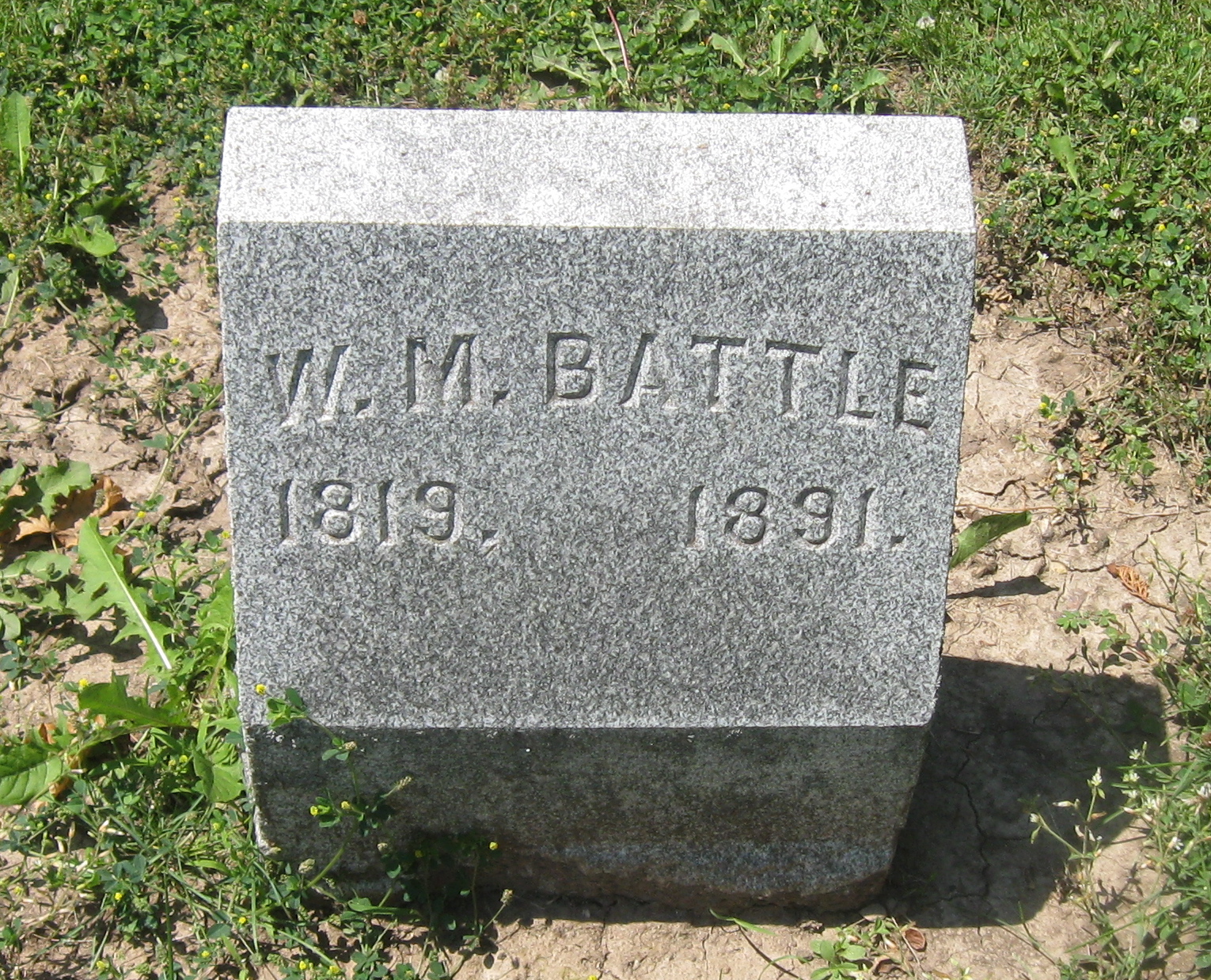
William Mills Battle (block 259)

This simple stone marks the resting place of a man who lived an eventful life.  He was born in Massachusetts in 1819, the youngest of four sons in a wealthy farming family. One of Battle's older brother was a disgrace, drinking and gambling away much of the family fortune and good name, so much so that they moved out of the area to Ohio.  It was William's early ambition to restore his family's reputation and finances. He inherited just twelve acres of land from his grandfather, and despite a spinal deformity which prevented him from engaging in traditional farming, he developed his skills as a cattleman, raising and selling quality beef.  His shrewd business acumen helped him to increase both his land holding and his fortune, allowing him to raise a family in the Buckeye state.  Then came the financial crash of 1875, which caught him unaware and cased him to lose his fortune.  This was a cruel blow, so much so that he left Ohio and brought his family to Janesville in 1877, and later to DePere, where he managed a hotel.  He eventually returned to Janesville, where he lived out the final years of his life, if not in wealth, at least in honor.


George Safford Parker (block 250)

The modest headstone in this family plot belong to the family of George Safford Parker, founder of the Parker Pen company.  Parker was a native of Shullsburg, and a graduate of Valparaiso in Indiana.  When he came to Janesville it was to first learn, and later teach telegraphy at Valentines School of Telegraphy. He was also a pen salesman for the John Holland Pen Company, also here in Janesville, and whose pens apparently often leaked or needed repair.  Parker tinkered and experimented and ended up inventing a better and more reliable pen, the Lucky Curve.  The new Parker Pen company started small in producing these pens, with the help of the infusion of money from William F. Palmer, and had offices in various buildings around Janesville, until 1919 when Parker Pen built its own headquarters at the intersection of South Division and East Court streets.  Over the years the Parker Pen company became an international success, with innovations such as the iconic Big Red pen, the vacumatic pen, and Quink, a special brand of quick drying ink.

John Meek Whitehead (block 253)

John Meek Whitehead was born in 1852 in Illinois, where he attended local public and prep school, and then when he was 25 he graduated from Yale, where he was school chums with William Howard Taft. He taught for a time, entered law practice in Chicago, married and began a family. By 1883 Whitehead had located in Janesville, where he operated a law office. He also had an impressive life of public service, serving sixteen years in the state senate., and helping to plan the new state capitol building after the original one was destroyed by fire. In Janesville he was president of the YMCA, and head of the library board of directors.  He also was a longtime curator for the Wisconsin State Historical Society.

George Wise (block 251)

I was interested that George Wise's monument has a second name in quotes under his name - "Bill Baxter."  Who was that?  Wise was English by birth, and emigrate with his mother when he was a child originally to Chicago, and later to Albion. He tried his hand at a number of professions - farming, manufacturing carriages, house painting, running a temperance pool hall. None worked out. Finally he turned to photography, and had a successful studio for many years in Janesville.  How about Bill Baxter?  After Wise died of a stroke, his obituary revealed the answer.  For years George Wise wrote poetry published in the Janesville Gazette and other publications under the pen name "Bill Baxter."

Joseph M. Bostwick (block 160)


You will need to cross the road and head back toward the chapel for the final stop on this walk, that of the founder of Bostwick's department store, Joseph M. Bostwick.  The Huling name is the one you'll see first, and Bostwick is on the other side of the monument.  

Joseph Bostwick was another transplant from New England; he came to the area when he was a teenager with his parents. Here in Rock county Joseph went to work in the general store of Bailey and Dimock, where he learned the ins and outs of general merchandising.  He also worked for other merchants, and eventually formed a partnership with O.K. Bennett, under the name Bennett and Bostwick. Around this time the way people liked to shop was gradually changing, and general  and dry-goods stores where the customer might haggle, and where the owner would select merchandise for the customer from a list, were being replaced by department stores that stocked a wide variety of goods, where prices were set, and the customer could browse.  Think something like Macys, or Marshall Fields.  J.M. Bostwick opened Janesville's first department store, and was for many years respected for quality goods and money-back guarantees.  J.M. Bostwick and Sons had a reputation for quality and good value.

One cold January day in 1909 J.M. Bostwick went out for a pleasant evening at the local Elks club, and dropped dead of a cerebral hemorrhage aad stroke.  His funeral was hugely attended and afterward his sons took over the business and expanded it further.  Bostwicks was a downtown fixture for years, until 1973 when the Janesville Mall opened, and it was clear that people's shopping habits were changing once more Bostwicks closed its doors forever in 1978.

Saturday, July 22, 2017

"Lite" Version of June 2017 Walk

I was happy to guide around forty folks on another Saturday morning walk on June 10th. It was warm, but the breeze and abundant shade made this walk comfortable. This was the second walk I planned by area, rather than by any particular theme, and it seemed to work quite well.  As usual the folks who are renovating the chapel had it open so people could see what has been accomplished so far, especially the stained glass windows, stripped wainscotting, and fresh plastering.

This walk starts near the chapel, and follows a large square following the road running uphill on
the right side of the chapel.


If you look to the right, you can see a family vault built into the hillside (block 49).  This is the Follansbee vault.  All identifying markings have been removed or have fallen away, but cemetery records show several family members in a vault in block 49, so this has to be it. Vaults were once popular, especially for wealthy families, but problems with upkeep and vandalism have caused them to be a thing of the past.


Heading up the hill, find the family monument for Oliver B. Ford (block 37).  Originally from Vermont, he came to Beloit and 1847, and a couple years later moved permanently to Janesville.  Ford operated a small in, but later built Ford's Grist Mill, one of the most successful flouring mills in the area during Wisconsin's wheat growing boom.


Not far from the Ford monument find the monument to the Judd family (block 38).  The Judds were a family of physicians, and originally they also had a family vault, though in 1908 they tore it down and reburied family members further up the hill.  Dr. William H. Judd was a popular local doctor for many year, although he was killed when he was struck by an automobile driven by a inexperienced teenage driver.  We also remember him because he donated a memorial window to the chapel dedicated to his young son, who died in a diphtheria epidemic.


Almost next door you will see the monument and headstones for famous singer, pianist and composer Carried Jacobs Bond.  She is buried in California, but her parents and first husband are here (block 39).  Dr. Frank Bond, who was a local man, died when he was only 37 in Michigan, when he was struck by a snowball, fell, and hit his head.  Carrie Jacobs Bond had to work extraordinarily hard to make a living for herself and her son, but she certainly made a success of herself. You may know one song she penned, "I Love You Truly."  Was she thinking of Frank?


A little further up hill and toward the road you will find the tall obelisk memorial to Edward V. Whiton (block 35). Whiton, a lawyer,  came to this area when it was still a territory, a secured a seat in the Territorial Assembly, and he collected and published the first set of territorial laws.  Later he was elected the first chief justice of the state Supreme Court.  He died  at the age of 54, and was remembered as an intelligent and prudent juror, and a man who showed courtesy to all.


Further still up the hill and to the right a bit is Peter Myers' monument (block 32).  Originally from France he came to this area trained as a butcher - his shop was on Main street where the Bodacious Shops are now.  He got into real estate and became investing in downtown buildings. In 1859-60 he built the Myers Hotel, and a decade later added on and made it the Myers Opera House, a center of Janesville culture for many years.


Just behind the Myers monument is this red stone monument which looks a little like a chess piece.  This marks the final resting place of James and Forbice Simpson, both from Scotland originally (block 31).  When Forbice was 80 years old and widow, she met a sad end, along with her adopted son.  Both were accidentally asphyxiated by gas from the cook stove.  Neighbors found them after several days worth of newspapers piled up on the porch.


Walk a bit closer to the road, and you'll find the Crosby lot, which has monuments to the James and Chester Crosby families, and to Laurence and Louise Crosby Roys (block 30).  James B. Crosby lived in the house on Sutherland and local resident will remember was also the first city hospital, Oak Lawn, and he was the general manager of the Janesville Manufacturing company.  The low newer monument to the Roys family is also worth a look. Laurence Roys was trained as an engineer, but became fascinated by trying the correlate the Spanish and Mayan calendars, and he led a number of expeditions to the Yucatan Peninsula in Mexico to study Mayan engineering.


Head back to the road and keep walk toward the back of the cemetery. On the right is the pretty white marble monument to the Conrad family (block 95).  Charles H. Conrad was from Ontario, but came here in 1849. He was a carpenter and millwright, and is remembered for building the "Big Mill" on the Rock River.  He also was a merchant, his store being where the Myers Hotel was later built. He was a member of the Board of Supervisors and a director of First National Bank.


Walking in the same direction, toward the back of the cemetery, find the Macloon monument - look for the large cast iron planter (block 94). This is an interesting monument. If you look at the image at the base of the monument you will see a sailing ship at anchor, the sails all furled, symbolic of a voyage completed.  Macloon, who made much of her personal fortune in real estate, was born in Massachusetts, where for a time he was a ship's captain, involved in general freighting between Boston and the West Indies. After a shipwreck near Cuba, he left shipping and moved to Rock county, where he bought land, built a fine house and raised horses, sheep, cattle and hogs.  He also owned a drug store and half share (along with Oliver Ford) in the post office.


Not far from the Macloon monument is the obelisk dedicated to Elizabeth Strunk Ripley (block 82).  She was the daughter of John and Eleanor Strunk, married to Mark Ripley. Today we remember her for her brave, but doomed efforts to save two young girls, Lucy Smith and Lulu Hanson, from drowning in the Rock River.  She drowned in her attempt to save the young women.  All three are buried in this plot.

Also nearby is the family monument to Joshua Gray (block 82). This area has had a number of breweries over the years, but the one that has lasted the longest, right up to the present, is Gray's Brewery.  Joshua Gray, of Irish extraction, moved his family to Janesville and began bottling both beer and soda water in 1856. The fact that he brewed both alcoholic and non-alcoholic beverages saved the company years later when Prohibition closed most other breweries. Gray just switched over to soft drinks.  Today of course the family has returned to brewing and bottling beer.


Continue walking the same direction, toward the back of the cemetery and find a family monument dedicated to the Culvers, shaped like a life-sized tree (block 83). Be sure to spend some time looking at this fascinating monument
and notice the twining ivy, rustic cross, inscribed names, book, and even a tiny mouse. The father in this family, H.P, Culver was originally from Connecticut, but moved to New York, where in 1817 he married Almira Lacy, to whom he was married 49 years.  He was a successful manufacturer there, known mostly for manufacturing barrels through the use of machinery.  In 1843 he moved his family to Janesville, where he engaged in farming.  He was a pioneer who witnessed Janesville's early growth.


As you continue toward the back of the cemetery, turn right at the cross road, which is Western Avenue.  On the right side are two monuments to the Spaldings (block 75). The one on the left in this photo is nice because it features a beautifully carved shock of wheat, symbolizing a long life lived to the fullest.  Stephen C. Spaulding (same family, different spelling) has no marker, probably because he committed suicide.  He had lived in Janesville, moved away, and had a downturn of fortune. He returned to the area after a 19 year absence, having run a jewelry store in Janesville and also having been a traveling salesman.  He shot himself on his young daughter's grave. A letter left to friends stated that he considered himself a failure and did not care to live. The Odd Fellows fraternal group buried him near his daughter's grave.


There is a faintly marked path running downhill near the Spalding headstones.  Take that, heading back toward the lower part of the cemetery.  On the right a few years along the path is the monument for William Hodson (block 76).  William Hodson was something of a Utopian, an English immigrant who lived in the town of Turtle.  We remember him today for having the first brewery in the area, though it was not long-lived, being destroyed early by fire.


Continuing on the footpath heading back toward the lower part of the cemetery, still on the right side, find the monument to the Arba Burris family (block 78). The stone looks like it is ready to slide off its base.  A.P. Burrus was quite a colorful person, a physician and dentist, an inventor, born in 1825 in Pennsylvania. He married Miss Mry Jones and they raised four children, two boys and two girls. The family lived in Milton Junction, and Dr. Burrus had a dental office in Janesville, and he traveled to a circuit of smaller towns performing "painless" dentistry and fitting dentures.  Despite his successful practice, his life was filled with tragedy, his daughters both dying of diphtheria, his younger son killed in a train accident, and the older one drowned.  He was a widower by the age of 40, and in the market for a wife. His search for a second wife was celebrated in both local and national newspapers when he wrote to a clergyman in Minneapolis who aced as a sort of matchmaker for respectable men and women.  He wrote a long letter outlining his requirements for a perfect new wife, including all her measurements, height, weight, general appearance (fine features and a well-developed chin).  Plus she should be a good cook and nurse.

He died unwed.


Friday, May 12, 2017

May 2017 Stories and Stones - The Basics


I'm excited about the first guided Stories and Stones walk at Oak Hill cemetery tomorrow! I've been planning it for so long, thinking about it, playing with the script, and so on.  The weather promises to be good, for which I am thankful.  If you decide to join me on the free hour-long walk, just came a little before 10 a.m. comfortably dressed and wearing sensible shoes.  I believe the Friends of Oak Hill Chapel will have the chapel open as well, so you can peek inside and see the wall of restored stained glass windows. 

If you cannot attend the walk, I have included Find a Grave links that give some of the same information I will be sharing.


These are the stops I plan to make on the walk.  All are in a big square behind the chapel, some of the oldest areas of the cemetery. 

1. Ithamar Conkey Sloan's family vault

2. Family plot of Corporal Frank E. Hilt

3. Family plot of Rev. Orin Dearborn

4. Family plot of Judge William Holmes

5. Family plot of Sergeant Henry Whittier

6. Family plot of Capt. William Dick Cargill,  Scottish sea captain


7.  The lovely rustic monument of Josie Kimball Conant

8.  Family plot of Levi Alden 

9.  Family plot of Levi St. John, early pioneer

10.  W.H. Sargent Post Grand Army of the Republic block

11. Memorial for James Croft, Medal of Honor winner

12. Family plot of John and Anna Roethinger, Janesville brewers

13. Headstone of Orlando Florida, the man, not the city

14. Family plot of James Harris, Janesville's "Father of Industry"


15. Family plot of Rev. Georg Kaempflein

16. Family plot of James Sutherland

17.  The old Public Grounds (Potters Field)

18. Family plot of General James Bintliff

19. The Odd Fellows block

20. Family plot of Gerald Braisher, equipment manager for Vince Lombardi

21. Family plot of Capt. Pliny Norcross

22. Family plot of Capt. Ira Miltimore