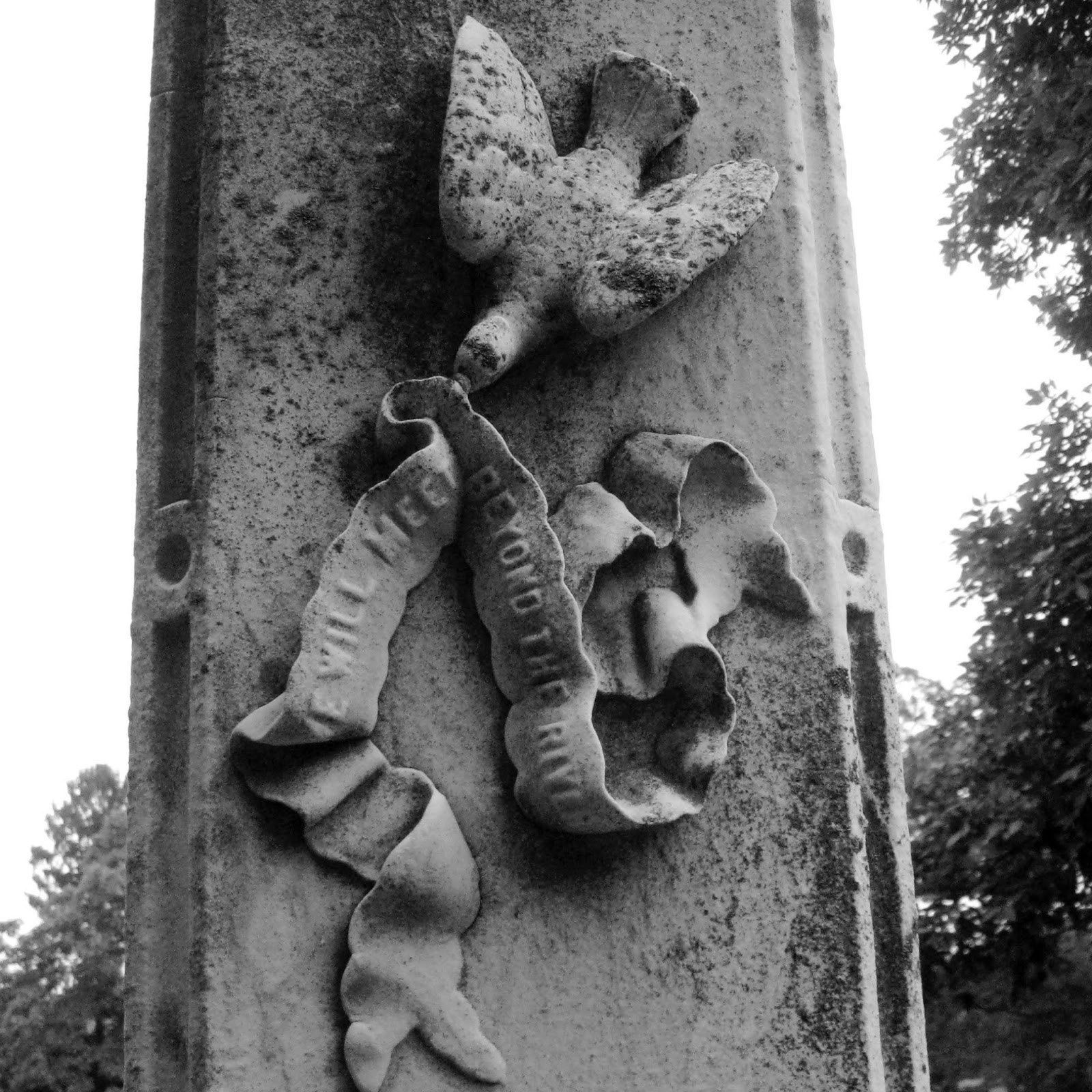
This is the script I used, and I've included some photos of images on headstones. I think it would be easy enough for anyone to do this walk on their own, especially if you download a map from the city website. The entire walk should take about an hour.
----------------------------------------------------------------------------------------------------------------------------
Welcome, Oak Hill, History Campers! I am Sherry, and I’m here to teach you a little about the history of Oak Hill cemetery, and take you on a walking tour to visit some interesting headstones and monuments, and also to help you understand what some of the symbols carved on those headstones mean. Have any of you visited this cemetery before? It covers about 90 acres, and contains the graves of more than 24,000 people.
Who knows when Wisconsin became a state? The answer is 1848. Oak Hill cemetery was started in 1851, not very long after Wisconsin became a state. Actually, Oak Hill was not Janesville’s first cemetery. There was once a cemetery where Jefferson Park is now, not far from the Rock County Court House. The earliest non-Native American settlers mostly came here from states like New York, New Hampshire, Vermont, Massachusetts and Rhode Island, looking for land. Those early settlers used the first cemetery. But by 1851 Janesville had grown so much that the city government decided they needed to build a new bigger high school on the land where the cemetery was, so they dug everyone up and carried the bodies across town to the new cemetery outside the city limits, Oak Hill. As you can imagine, not everyone was thrilled to have their relatives dug up and moved, but the new cemetery was a better place than the old one in the middle of the city, and Janesville needed a centrally located high school, so it was done.
For years and years the cemetery was run by the Oak Hill Cemetery Association, and they sold all the plots, put in fences and roads and gardens, cut the grass, and in 1900 built the chapel, which was a place to have funerals. Sometimes, when the ground was frozen hard in the winter, caskets were stored in the basement until spring when a grave could be dug. There was a trap door in the floor of the chapel and a sort of elevator operated by pulleys to bring up the coffin. Anyway, a few years ago the Cemetery Association was disbanded, and the city of Janesville took over running the cemetery. They run it today.
The chapel is interesting. The plans were drawn up by a local architect, a man named Sutton Norris. It was built of local limestone with a slate roof, and had large gothic style stained glass windows, including a round rosette window over the front doors. There was a circular driveway in front, and a fountain. A little over ten years after the chapel was built, the Cemetery Association added a red brick covered porch, so that horse drawn wagons could pull up to the front steps out of bad weather. Eventually the porch became unsafe and had to be removed.
In fact the whole chapel became quite run down over time. Many of the windows were damaged or broken entirely out, the wood trim inside was painted over and the plaster was peeling. The light fixtures were broken, and little by little people stopped using the chapel for funerals, and even stored maintenance equipment inside. The city thought it would be too expensive to make the chapel safe and attractive again, and considered tearing it down. But a local group of volunteers raised money and donated their time and hard work to fix the foundation and roof, strip off the old paint, add new light fixtures, refinish the floors, and completely rebuild the damaged stained glass windows. They also built new front steps and landscaped the front of the building. Everyone is very excited about how well it turned out, and now the chapel can be used again.
Lets take a special look at the windows, starting with the round one over the front doors. The original window was destroyed many years ago, and nobody today knew what the design was. They only knew that the widow was dedicated to an organization called the Knights of Pythias. So a new widow was designed, using the insignia of the Knights of Pythias. The letters F,C,B, stand for Friendship, Charity, and Benevolence. The windows on the sides are gothic style, which simply means they have a pointed arch at the top. Each one has a small round picture, and each picture stands for a religious idea. For example, over here is a picture of an anchor. The idea is that Christ saves people’s souls, just like an anchor saves their lives at sea. You will see images of anchors on some monuments in the cemetery. Then there is a sheaf of wheat. When the chapel was built wheat was the largest crop grown in Wisconsin, but besides that, the idea is that wheat is harvested at the end of the growing season, just as when people reach the end of their lives, God gathers in their souls. The intertwined letters represent the Greek version of Christ’s name, and the book is supposed to be the Bible. When you are walking around the cemetery, keep your eyes open for similar images. Over on the other side we see a dove, which is the symbol of peace, lilies, which represent purity, a lamb which might stand for Christ or for innocence, and a crown and cross, which is the symbol for another organization, the Knights Templar. But also you know the cross is a Christian symbol, and those who go to heaven are supposed to wear a crown. Once you are looking for them, you will see many of these symbols, and others, on headstones and monuments.
We are just about ready to go out into the cemetery and take a walk. But first off, here are some things you will not see - old Puritan headstones with skulls, wings, cherub faces, and hourglasses, the sort of thing you think of associated with Halloween. Early New England churchyards had those stern sorts of headstones, and they were meant to remind people of the shortness of life, and the need to live a good life before meeting St. Peter at the pearly gates. They often had verses like this:
Death is a debt
To Nature due
That I have paid
And so must you.
Oak Hill is a newer public burial ground, not associated with any one church. It was designed to be more modern, outside the city limits, like a pretty country garden. People were supposed to be able to come here as they might to a park, to look at nature, trees, birds, and flowers. The headstones are not meant to scare you into behaving well, but rather to express sadness over the loss of a loved relative or friend, and to express hope that his or her soul might be at peace in heaven. The older headstones and monuments here are easy to spot. They tend to upright and vertical, and sometimes are quite large. They might look like a column, or rather like the Washington Monument, a shape called an obelisk. Some have statues, some look like trees, and at least one is designed to be a raised flower bed. Let’s get started. Just remember, watch where you step, and be careful not to step or sit on any of the headstones.
Ithamar Conkey Sloan: vault
Dearborn family: tree and cross (block 16)
Morris Carter Smith: broken column and wreath (block 17)
Odd Fellows area: interlocking rings (explain neighborhoods like Masons, Babyland, veterans)
Sergeant Henry Whittier: eagle and shield, hands, bible, dove, (block 96)
Josie Kimball Conant: rocks, ivy, lily, flower bed (block 97)
GAR Civil War section: military headstone, cannon muzzles and cannon balls
Augusta Tallman Beach: lady with anchor and palm leaves (block 90)
Ephraim Spalding: sheaf of wheat (block 75) - also Ira: anchor
Emma Matilda DeBaun: resting lamb (block 91)
Captain George Bentley: Civil War cap sword and shield (block 91)
Charles A. Brown: Father Time and the Weeping Virgin (block 91)
Thomas Jeff Nichols: railroad car (block 91)
Culver family: tree (block 83)
Captain William Macloon: sailing ship (block 94)
Alice Crosby: statue of lady, anchor (block 30)