Showing posts with label headstones. Show all posts

Monday, June 25, 2018

History Camp Youth Tour

I was given the opportunity to lead a tour of Oak Hill for Janesville's History Camp, run by the School District of Janesville for students in 5th through 8th grade.  It was a beautiful June day, and we were lucky to be able to start the tour inside the newly renovated chapel, where I explained a little of the history of the cemetery and of the chapel, and paid special attention to the imagery on the stained glass windows, which is repeated in many headstones and monuments.

This is the script I used, and I've included some photos of images on headstones.  I think it would be easy enough for anyone to do this walk on their own, especially if you download a map from the city website.  The entire walk should take about an hour.
----------------------------------------------------------------------------------------------------------------------------
Welcome, Oak Hill, History Campers!  I am Sherry, and I’m here to teach you a little about the history of Oak Hill cemetery, and take you on a walking tour to visit some interesting headstones and monuments, and also to help you understand what some of the symbols carved on those headstones mean.  Have any of you visited this cemetery before?  It covers about 90 acres, and contains the graves of more than 24,000 people.

Who knows when Wisconsin became a state?  The answer is 1848.  Oak Hill cemetery was started in 1851, not very long after Wisconsin became a state.  Actually, Oak Hill was not Janesville’s first cemetery.  There was once a cemetery where Jefferson Park is now, not far from the Rock County Court House.  The earliest non-Native American settlers mostly came here from states like New York, New Hampshire, Vermont, Massachusetts and Rhode Island, looking for land.  Those early settlers used the first cemetery.  But by 1851 Janesville had grown so much that the city government decided they needed to build a new bigger high school on the land where the cemetery was, so they dug everyone up and carried the bodies across town to the new cemetery outside the city limits, Oak Hill.  As you can imagine, not everyone was thrilled to have their relatives dug up and moved, but the new cemetery was a better place than the old one in the middle of the city, and Janesville needed a centrally located high school, so it was done.

For years and years the cemetery was run by the Oak Hill Cemetery Association, and they sold all the plots, put in fences and roads and gardens, cut the grass, and in 1900 built the chapel, which was a place to have funerals.  Sometimes, when the ground was frozen hard in the winter, caskets were stored in the basement until spring when a grave could be dug.  There was a trap door in the floor of the chapel and a sort of elevator operated by pulleys to bring up the coffin.  Anyway, a few years ago the Cemetery Association was disbanded, and the city of Janesville took over running the cemetery.  They run it today.

The chapel is interesting.  The plans were drawn up by a local architect, a man named Sutton Norris.  It was built of local limestone with a slate roof, and had large gothic style stained glass windows, including a round rosette window over the front doors.  There was a circular driveway in front, and a fountain.  A little over ten years after the chapel was built, the Cemetery Association added a red brick covered porch, so that horse drawn wagons could pull up to the front steps out of bad weather.  Eventually the porch became unsafe and had to be removed. 

In fact the whole chapel became quite run down over time.  Many of the windows were damaged or broken entirely out, the wood trim inside was painted over and the plaster was peeling.  The light fixtures were broken, and little by little people stopped using the chapel for funerals, and even stored maintenance equipment inside.  The city thought it would be too expensive to make the chapel safe and attractive again, and considered tearing it down.  But a local group of volunteers raised money and donated their time and hard work to fix the foundation and roof, strip off the old paint, add new light fixtures, refinish the floors, and completely rebuild the damaged stained glass windows.  They also built new front steps and landscaped the front of the building.  Everyone is very excited about how well it turned out, and now the chapel can be used again.

Lets take a special look at the windows, starting with the round one over the front doors.  The original window was destroyed many years ago, and nobody today knew what the design was.  They only knew that the widow was dedicated to an organization called the Knights of Pythias.  So a new widow was designed, using the insignia of the Knights of Pythias.  The letters F,C,B, stand for Friendship, Charity, and Benevolence.  The windows on the sides are gothic style, which simply means they have a pointed arch at the top.  Each one has a small round picture, and each picture stands for a religious idea.  For example, over here is a picture of an anchor.  The idea is that Christ saves people’s souls, just like an anchor saves their lives at sea.  You will see images of anchors on some monuments in the cemetery.  Then there is a sheaf of wheat.  When the chapel was built wheat was the largest crop grown in Wisconsin, but besides that, the idea is that wheat is harvested at the end of the growing season, just as when people reach the end of their lives, God gathers in their souls.  The intertwined letters represent the Greek version of Christ’s name, and the book is supposed to be the Bible.  When you are walking around the cemetery, keep your eyes open for similar images.  Over on the other side we see a dove, which is the symbol of peace, lilies, which represent purity, a lamb which might stand for Christ or for innocence, and a crown and cross, which is the symbol for another organization, the Knights Templar.  But also you know the cross is a Christian symbol, and those who go to heaven are supposed to wear a crown.  Once you are looking for them, you will see many of these symbols, and others, on headstones and monuments.

We are just about ready to go out into the cemetery and take a walk.  But first off, here are some things you will not see - old Puritan headstones with skulls, wings, cherub faces, and hourglasses, the sort of thing you think of associated with Halloween.  Early New England churchyards had those stern sorts of headstones, and they were meant to remind people of the shortness of life, and the need to live a good life before meeting St. Peter at the pearly gates.  They often had verses like this:

Death is a debt
To Nature due
That I have paid
And so must you.


Oak Hill is a newer public burial ground, not associated with any one church.  It was designed to be more modern, outside the city limits, like a pretty country garden.  People were supposed to be able to come here as they might to a park, to look at nature, trees, birds, and flowers.  The headstones are not meant to scare you into behaving well, but rather to express sadness over the loss of a loved relative or friend, and to express hope that his or her soul might be at peace in heaven.  The older headstones and monuments here are easy to spot.  They tend to upright and vertical, and sometimes are quite large.  They might look like a column, or rather like the Washington Monument, a shape called an obelisk.  Some have statues, some look like trees, and at least one is designed to be a raised flower bed.  Let’s get started.  Just remember, watch where you step, and be careful not to step or sit on any of the headstones.

Ithamar Conkey Sloan: vault
Dearborn family: tree and cross (block 16)
Morris Carter Smith: broken column and wreath (block 17)
Gerald Braisher: Packer “G” (block 23)
Odd Fellows area: interlocking rings (explain neighborhoods like Masons, Babyland, veterans)
Sergeant Henry Whittier: eagle and shield, hands, bible, dove, (block 96)
Josie Kimball Conant: rocks, ivy, lily, flower bed (block 97)
GAR Civil War section: military headstone, cannon muzzles and cannon balls
Augusta Tallman Beach: lady with anchor and palm leaves (block 90)
Ephraim Spalding: sheaf of wheat (block 75) - also Ira: anchor
Emma Matilda DeBaun: resting lamb (block 91)
Captain George Bentley: Civil War cap sword and shield (block 91)
Charles A. Brown: Father Time and the Weeping Virgin (block 91)
Thomas Jeff Nichols: railroad car (block 91)
Culver family: tree  (block 83)
Captain William Macloon: sailing ship (block 94)
Alice Crosby: statue of lady, anchor (block 30)
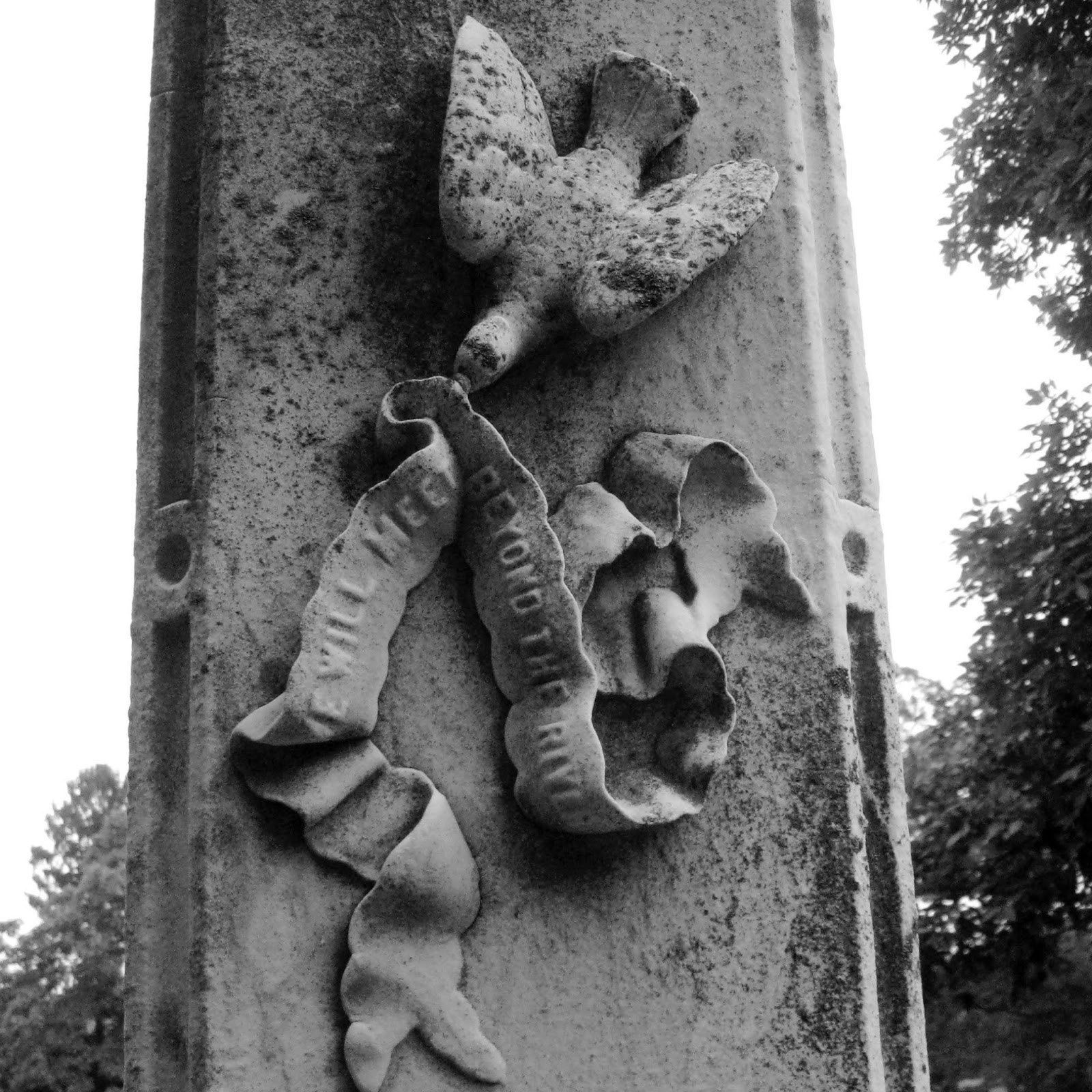


Friday, May 11, 2018

May Tour for the Association for Gravestone Studies

This walk is designed for out-of-town visitors to historic Oak Hill cemetery, who might not recognize local names from city street and county road names or from historic buildings or parks.  The walk is a fairly compact circle walk that showcases selected outstanding monuments and headstones, and mentions some names that might be familiar to people coming from outside of Rock County.  It also shows how the symbols in the chapel stained glass are repeated in some of the headstones and monuments.

Oak Hill cemetery today covers more than 90 acres, and contains more than 24,000 graves, about half its capacity.  The oldest blocks are located on either side of the road that runs uphill to the right of the chapel, and this walk is limited to these areas.  Although there are thousands of interesting monuments dedicated to Rock County residents, there are hundreds of unmarked burials as well, so when you see an open space, do not assume the space is empty.  At Oak Hill it is nearly impossible to avoid treading on the dead.  

There are some fairly famous people buried here, from military heroes from many conflicts such as Medal of Honor recipient James E. Croft, to athletes like race car driver Stan Fox or lightweight boxing champion Sammy Mandell, to politicians such as congressman Stephen Bolles.  There is even the third director of the National Park Service, Arno Cammerer, who has a peak in the Great Smoky Mountains named after him.  Then of course there is George Parker, who founded the world famous Parker Pen Company.

Oak Hill is Janesville's oldest operating burial ground, but not its first.  The first cemetery was located where Jefferson Park is now, in the old Courthouse Hill neighborhood.  This first cemetery served the area's earliest pioneer settlers, most of whom came to Rock County in the 1830's and 1840's, many of them Yankees from New England.  Janesville grew quickly, and by 1851 city leaders decided to build a public high school on the site of the original village cemetery.  This caused an outcry for a number of reasons, not the least of which was that the early settlers buried in that location had to be dug up and carted across town to the new cemetery and re-interred, on land outside the city limits donated by the Rock County Board of Supervisors, Oak Hill.

For many years the Oak Hill Cemetery Association oversaw the operation and maintenance of the burial ground.  They sold lots, paved roads, planted trees and bushes, maintained fences, fountains and gardens, and in 1899-1900 built the chapel, whose renovation is nearly complete.  The cemetery association was dissolved several  years ago, and the cemetery is currently being operated and maintained by the City of Janesville.

Oak Hill is is an example of a rural garden cemetery, similar to, though smaller than cemeteries like Mount Auburn cemetery, near Boston, or Forest Home in Milwaukee.  It was designed to celebrate nature, with roads and paths that follow the contours of the land, landscaping and gardens, and many mature trees.  It was intended to be, besides a place to respectfully bury loved ones, a beautiful public park where people could go to enjoy nature, perhaps even enjoy a picnic.  The monuments and headstones in these rural cemeteries, unlike the practical low maintenance markers popular today, tended to be vertical in a style which demonstrates the popularity of classical Greek and Roman architecture, and all things Egyptian.  So visitors see columns and obelisks, urns, sculptures, and monuments that resemble small temples.  Around the time that Oak Hill was established technical advancements made it easier to carve and transport very hard stone, so while there are many markers carved in soft limestone and marble, we also see many carved in durable granite.

The first stop on the walk is at the hillside vault of the family of Ithamar Conkey Sloan.  Sloan was a congressman who served during Abraham Lincoln's administration, and was associated with the University of Wisconsin law school.  Today there are only two family vaults at Oak Hill, this one and one on the other side of the road, that belonged to the Follansbee family.  Originally these vaults had marble facings, with the names of family members engraved on them, but all these decorations are now gone, either due to weathering or vandalism.  I know of two other vaults here that have been removed.  Before the chapel was built there was a vault for storing bodies in the winter, when the ground was too hard to dig, and the Judd family had a vault, but they tore it down in 1908 and reburied family members in traditional graves which we'll see later.

I.C. Sloan family vault (block 6)

One of the newly restored stained glass windows in the chapel features a lamb and flag, which is a visual representation of Jesus as the Lamb of God.  Most of the lambs on headstones here at Oak Hill are similar to this one for young George Carle.  Lambs can also represent innocence.

George Carle lamb (block 6)


There are two family monuments at Oak Hill which are in the shape of a tree trunk with lopped off limbs representing departed family members.  Monuments like these used to be fairly common, and it's fun to try and spot them in a wooded cemetery.  This one is for the Orin Dearborn family, and it features twining ivy and a cross.  Notice the small carved logs that mark the boundaries of the plot. Orin Dearborn was a Baptist minister here in Janesville.

Rev. Orin Dearborn family tree monument (block 16)

When I take people on tours of the cemetery this headstone is always a favorite.  Gerald "Dad" Braisher was Packer football coach Vince Lombardi's equipment manager.  Mr. Braisher was the person who designed the now famous Packer "G" seen on the helmet here.

Gerald Braisher - Packer "G" logo (block 23)

We're stopping at the family monument of Capt. William Dick Cargill, both because it is a lovely featuring lilies and palm fronds, but because the Cargill name is so widely known.  Captain Cargill was born in the Orkney Islands of Scotland and sailed out of Scotland first, and later out of Long Island.  His wife Edna was reported to have hated the sea, and did not want any of her four sons to grow up near it.  So Capt. Cargill retired to Rock County and became a gentleman farmer, and their sons founded the Cargill grain business that eventually became the agribusiness giant we know today.

Capt. William Dick Cargill family monument (block 23)

This stop at the Kimball family plot is to see the beautiful monument belonging to Josie Kimball Conant.  Her parents ran a successful hardware business here and in Missouri, and she  married Conant in 1879.  Her rustic cradle monument features a rock wall, various flowers, ferns, ivy, and a curbed area that originally held a flower bed.  Watch out walking here - there are woodchuck burrows!

Josie Kimball Conant -  rusticated flower bed (block 97)

This block is dedicated to members of the W.H. Sargent Post No. 20 of the G.A.R., Grand Army of the Republic.   More than 2, 800 Rock County men served in the Civil War, and the local G.A.R. Post was organized in 1881 with 42 charter members, and was named after Lt. W.H. Sargent of the 8th Wisconsin Volunteer Infantry Regiment who was killed in 1864 in Tennessee.  Some of these stones mark actual burials and some are cenotaphs.  The corners of the block are marked by small cannon muzzles and cannon balls.  Interestingly, W.H. Sargent is buried elsewhere in the cemetery.

W.H. Sargent Post No. 20 G.A.R.  (block 99)

Just a quick stop here to mention on of my favorite unusual names here at Oak Hill.  There are lots of interesting names, like Electa Bangs, Joe Blow, or Manley Fish.  But I like Orlando Florida's name especially well.  One of the men who mows grass in the summer told me when his supervisor asked him how far he got in his mowing, he replied "as far as Orlando Florida."
 

Orlando Florida (block 101)

Up the road from the Florida family, and across from the Tallman plot is a large wooded area that have relatively few headstones.  This is the public grounds, also known as the Potter's Field area of Oak Hill, where those who cannot afford to purchase a cemetery plot are buried.  There are many indigent men and women, itinerant workers, and children buried here.  Sometimes the families added a headstone later, so some of the burials are marked, but most are not.

Public Grounds (Potter's Field, block 121, 122, 123)

The impressive red granite monument here marks the plot of the William Morrison Tallman family.  Today the Tallmans' homes are maintained and operated as public attractions by the Rock County Historical Society.  William Morrison Tallman's house is a lovely brick home where Abraham Lincoln really did spend a couple of nights when he was running for President.   The pretty white marble monument featuring a young woman pointing toward heaven next to the family monument is dedicated to Augusta Tallman Beach, who died as a young wife in Chicago.

Augusta Beach and the Tallman family (block 89)

Elias Childs was a stone cutter from New York, and while his headstone is plain, those of his wife and daughter are anything but plain.  Dia and Frances Childs' stone is a pair of short tree trunks on a low wall of rocks, each with a scroll, rope tied in a knot, and rose - in one in full bloom and one in bud. 

Dia Childs and daughter's rusticated headstone (block 86)

I do not know very much about Ephraim Spalding, other than he was the son of a veteran of the War of 1812, but I have always admired the sheaf of wheat that marks his resting place.  You probably remember the same symbol on the window in the chapel, representing a life come to fruition.

Ephraim Spalding - Sheaf of Wheat (block 75)


Notice the small marker dedicated to "Ira," with the symbol of the anchor.  This symbol might stand for the idea of hope, or safety, or even be a veiled reference to the holy cross.

Ira - Anchor (block 75)
 

If you look across the road you'll see a large monument dedicated to Janesville Freemasons  Many headstones at Oak Hill feature the compass and square, this monument features Masonic symbols on each of the four faces of the marker, including the cross and crown of the Knights Templar, which you will remember from the window in the chapel.

Masonic Monument - Knights Templar symbol of cross and crown (block 157)


Speaking of Masonic symbols, this headstone marking the final resting place of Charles A. Brown, features a broken column, a weeping virgin with a book, and a sprig of acacia, an urn, and Father Time holding a scythe.  All are symbols of mortality, but this particular image is related to Freemasonry.  Charles Brown was a dedicated Mason.

Charles Brown - Father Time and the Weeping Virgin (block 91)

It is unfortunate that Thomas Nichols' headstone has recently toppled.  I've always liked the image of the train car on his marker.  In life he was a conductor for the Chicago and Northwestern railroad.

Thomas Nichols - train car (block 91)

 George Bentley fought for the Union in the Civil War, and was killed in Perryville, Kentucky, in 1862.  His impressive stone includes a shield, sword, and his cap.

Capt. George Bentley - cap, shield and sword (block 91)

Heading back toward the chapel off to the left it is easy to miss the other large tree monument at Oak Hill, dedicated to the family of  Henry Culver.  Culver, originally from New York, made his fortune in manufacturing in New England, and later in life moved to Rock county to farm.  The monument features many unique touches including a cross, a book at the base of the tree with family names inscribed, and even a tiny mouse.

Henry Culver family tree monument (block 83)

This is the family plot for the James Crosby family.  Crosby was a wealthy man from New York who  came to Janesville in 1852 and became the general manager of the Harris Manufacturing Company, and later an was an officer of the Rock County National Bank.  He is buried here with his wife Andalusia, and daughters Alice and Jessie.  I like to think the pretty girl featured on their monument represents their daughter Alice, who died as a schoolgirl in New York of scarlet fever.   The figure points to heaven, and holds a scroll and an anchor, and there is also a dove similar to the one featured on the chapel window.

James Crosby and family - lady, dove, anchor (block 30)

 The tall gray granite obelisk ahead marks the burial spot of Judge Edward Whiton, a man important in Wisconsin history.  Originally from Massachusetts, he came to the Wisconsin Territory in 1836 and became a member of the Wisconsin Territory assembly the following year.  When Wisconsin became a state in 1848, Whiton was elected circuit judge, and joined four other circuit judges to form the first Wisconsin Supreme Court.  He was elected chief justice in 1853, and served with integrity and honesty.

Judge Edward Whiton and family (block 35)

You may remember the memorial window in the chapel dedicated to William Starr Judd.  The young boy was the son of Dr. William Judd, a well respected local doctor who came from a family of physicians.  The son died from diphtheria after accompanying his father to a patient's home during a local outbreak, and became infected himself. 

Dr. William Judd and family - memorial window in chapel (block 38)


Our last stop today is at the family plot of several family members of Carrie Jacobs Bond, widely considered the first great American woman composer, who penned The End of a Perfect Day, and I Love You Truly. Carrie is buried in California, but her second husband, Frank Lewis Bond, is buried here.  He married Carrie in 1888, and died only seven years later after suffering a fall.  Hannibal Jacobs and Mary Davis Jacobs Minor, Carrie's parents, are also buried here.

Dr. Frank Lewis Bond and family - husband of Carrie Jacobs Bond (block 39)

This concludes today's tour.  I hope you had a "perfect day" here at Oak Hill, and enjoyed getting a little overview of this lovely cemetery.  Thank you for coming, and please watch your step on the road as you return.


Wednesday, April 26, 2017

Spiffing Up


Things are greening up at Oak Hill, and I see lots of recent activity, from family members visiting to clean and decorate graves, to city workers and volunteers doing cleaning, maintenance and providing upgrades. Recently the city remodeled inside the office, and last week the exterior landscaping got an upgrade as well.


The mausoleum behind the office is getting sidewalks and landscaping, which should improve its visibility and aesthetics.


The new street sign looks great, and should make it easier for visitors to find the entrance, and also to distinguish Oak Hill from its neighbor, the Catholic cemetery, Mount Olivet.


Last week, in honor of Earth Day, the city, The Oak Hill Preservation Society, and student volunteers from UW Whitewater spent the morning doing a wide range of clean-up tasks, from planting bushes, to trimming, to picking up winter fallen branches, and even cleaning headstones, these folks worked hard to make a difference.


Visitors to Oak Hill will notice fifty new wren houses and robin nesting platforms around the property. place there by a partnership between local Boy Scouts and the Oak Hill Preservation Society - working together to bring a little more wildlife to the cemetery.

Monday, October 24, 2016

Unfortunate Events - Three


Here in southern Wisconsin the hardwoods are reaching peak color, and although the weather is gradually getting more brisk each day, it is still a fine time to take a stroll at Oak Hill; just dress for the weather. This walk is in the same general area as the previous one, to the right of the large road running uphill to the right of the chapel.  All these folks also met quite unfortunate ends.  As you search for these stones, keep your eyes open for other interesting sights around you, other monuments, the colorful trees, and perhaps some deer, fox or turkeys.


1. Eunice Wilcox (block 73) You are looking for a red granite headstone. Eunice married four times, and her last husband, Charles Wilcox, was her undoing.  She had some money, and he wanted to borrow it for investing in a real estate deal downtown. When she refused there was a fight, and he strangled her. He stayed with her remains several days before drinking poison and turning on the illuminating gas.  He is buried in an unmarked grave in the area behind the chapel. She rests here with a previous husband.

2. Stephen Spaulding (block 75)Mr. Spaulding's final resting place is unmarked, but there are several other nice family monuments on the plot. I like the one featuring a shock of wheat. Stephen Spaulding was a jeweler who had a shop in Janesville a number of years.  He moved away, and after having suffered all manner of health and job difficulties, moved back to town.  He went to his daughter Clara's grave at Oak Hill and committed suicide.

3. Townsend Sager (block 78) The headstone you want in a small flat gray granite stone. Mr. Sager was driving north on Milton Avenue with a wagon load of fertilizer for his farm when he was stricken by a fatal heart attack and fell to the road.  Several people rushed to his aid, but were unable to save him.

4. David Burrus (block 78) The Burrus family monument is a good sized gray granite stone.  The boy's father was a local dentist and inventor, with a colorful personality.  But the family was visited by tragedy more than once. David's two sisters perished in a diphtheria epidemic, his older brother was convicted of killed two women and later drowned, and he was killed when he tried to catch a ride on a train with two of his friends, and was caught between the cars, and fatally injured.

5. Lucy Smith, Elizabeth Strunk Ripley, Lulu Hanson (block 82) Look for a tall gray granite obelisk under trees.  This story is well known by local residents.  Elizabeth Strunk drowned in the Rock River trying to save her cousin Lucy Smith and Lucy's young friend Lulu Hanson when they were caught in the river's currents.  All three are buried together in this family plot.

6. Charles Antisdel (block 82) Nearby you will find a slightly shorter gray monument to the Antisdel family. Charles has a smaller headstone as well. Many of the people buried at Oak Hill were the victims of train accidents, but railroad employees and other folks,  Charles died in Kempton, Wisconsin, the victim of a train wreck.

7. Thomas Bennett (block 91) The Bennett family monument is a newer red granite stone with three names engraved upon it. Thomas Bennett was a well-known conductor on the Chicago and North Western line. He was accidentally thrown from the train when the train slowed to cross the Fox River near Chicago, and cars bumped into one another.  His body was found in the river a day later, with bruises on the back of his head.

8. Edna Conrad (block 95) Edna's headstone is a low white marble block.  She was married to William Conrad, a well-known local grocer.  Her obituary says she was sick for three weeks before dying of ptomaine poisoning - what we think of today as food poisoning.


Thursday, October 13, 2016

Unfortunate Events - Two

This is another walk that should take less than an hour that you can take to visit the final resting places of local residents who long ago met unfortunate ends.  All of these stops are located to the right of the road running up the hill by the chapel.  Some are on the side of the hill, others further on.  A map, either from this blog or from the cemetery office will be very helpful.  As you search for the stops, be sure to look around you.  There are many, many interesting headstones and monuments, and if you keep a sharp eye you'll see all sorts of birds (including turkeys) and animals, from woodchucks and fox to white tailed deer.


As always, watch your step, as there are uneven places and animal burrows, and don't lean or, sit on, or step on old stones. Safety first!

One quick note, my walks are mostly centered on folks who traveled "to the land beyond" a hundred years ago or more.  There are a couple reasons for this choice.  First off, the old monuments and headstones tend to be more interesting than modern markers.  But also I am interested in relating historical stories, and do not want to stir up any unhappiness in visitors who might remember the person buried beneath the stone.

1. Alice Crosby (block 30) It's impossible to miss the pretty marble column topped by a girl with a scroll and anchor, pointing (with a missing finger) toward heaven.  Alice was the daughter of a wealthy family, sent East to boarding school when she passed away after having contracted scarlet fever.

2. Forbice Simpson (block 31) The Simpson monument is an attractive red granite column, topped with a sphere. The Simpsons were from Scotland. She and her husband James were asphyxiated by fumes from their kitchen stove.

3. Albert Kalvelage (block 33) The Kalvalege monument is a large gray granite rectangle, topped with a shape that looks something like a roof. Albert studied law, and was the official court reporter in Janesville.  He apparently was distraught after the accidental death of his young daughter, and he took his own life by both jumping off a bridge into the Rock River and shooting himself.

4. James Monroe Edwards (block 33) The Edwards family monument is also a gray granite stone shaped a little like a house, and there is a palm leaf inscribed around the initial "E." James worked on the railroad. He slipped and fell between a caboose and a freight car on the Madison to Milwaukee line and later died of lock-jaw.

5. Dr. William Judd (block 38) The Judd family monument is still another good-sized gray granite rectangle with a slanting top.  Dr. William Judd, one of a family of several physicians, was accidentally killed in an automobile accident.  He was struck in the street by young Robert Bliss.

6. Rose Allen (block 40) Mrs. Allen's headstone is a small gray granite one.  She was killed in Solon Springs, hit by a train when she went to the station to meet her daughter. The newspaper said there were two trains coming, and when she stepped out of the way of one, she was hit by the other.

7. Ellen Addy (block 48) A large gray monument marks Ellen Addy's final resting place.  Her story is a sad one, and not the only one like it at Oak Hill.  The elderly woman was a widow, residing alone, her children all living out of town.  She was found on the floor in her night clothes, covered in coal dust.  She had been trying to rebuild her fire when she collapsed.  Though friends found her while she still lived, she died soon after.

8. Humphrey Roberts (block 60) Another gray granite monument, this one with a curved top, serves the Roberts family.  Humphrey was shot and killed in the farm of J.C. Jenkins.

9. Amy Yeo (block 64) This time you are looking for a narrow four-sided column, under some pine trees, not far from a road leading up the hill.  Mrs. Yeo, also a widow, was somehow injured on her foot, and died two months later of gangrene.

10. Benjamin Franklin Downing (block 65) The white marble Downing monument is nearby, on the side of the hill.  You will spot it easily, because the smaller monument to their young daughters has fallen off its base and is propped up. Downing, originally from Pennsylvania, was fatally injured on his farm during a wind storm.  The heavy door of his barn blew violently against him and fractured his skull. Years later his wife was seriously injured on a railroad accident, which left her an invalid, until she finally succumbed to the effects of a stroke.

Interested in learning more? Visit Find a Grave, Oak Hill, Janesville, and type the name of whoever you want in the search box.  All of these people have photos of headstones, and often more information.


Monday, October 10, 2016

Unfortunate Events Walk - One

Last week I led the first three twilight walks for the Rock County Historical Society, the ones that because of their nearness to Halloween are called Chill at Oak Hill.  The last three are later this week. The emphasis in this walk is on creepiness, and we walk to the monuments of people who expired from awful accidents or murder, or who claimed to have psychic powers, or who were in some way associated with local ghost stories.  As last year was popular, this year's tour is also drawing crowds, many of whom have never been on one of my walks, or even who had never set foot in Oak Hill before this tour.  I found myself using a phrase over and over, even though it was not originally in my script - I found myself describing a person's demise as "an unfortunate event."  Probably I just remember that popular series of spooky young adult novels whose titles include those words.


But it's true. While the majority of folks who "passed to the land beyond" died of ordinary causes, old age, diseases, infections, heart disease and strokes, some died in more unusual ways. Memorable ways. Unfortunate ways.

This month I plan to post some walks you can easily do at Oak Hill that feature people who suffered some very unfortunate events.  All my little tours can be done in an hour or so, and I have grouped the monuments and headstones together by area.


What You Need

Dress for the weather, including sensible shoes.  The pavement and the ground can be very uneven, and there are low spots and woodchuck holes that may be covered with fallen leaves.  Good shoes make you more sure-footed.

You also need a cemetery map to more easily find the blocks.  I posted one earlier that you can run off (use the search box), or get one at the cemetery.  The "Rules" sheet provided by the city has a map on the back, or you can stop by the office M-F, 10 a.m. until 2 p.m.

All the stops on this walk are in the section behind the chapel, the area between the roads that run up the steep hill.  If you want more information you can search for these people on Find a Grave.  Use this hyperlink, or  search for Find A Grave Oak Hill Janesville, then type the name in the search box.  There are photos of each stone on the website as well.


1. Bert Grodivant (block 6) Monument features the logo for Woodmen of the World. Bert died when his arm was torn off in a well-digging accident.

2. Sarah Bull (block 19) Sarah's stone is just a plain gray granite headstone, but her story is colorful. While postmistress in Kansas, she witnessed the death of her husband Hiram, when he was attacked by an elk.  Originally from Janesville, she returned afterward and lived here until her death.

3. Pliny Norcross (block 20) Norcross' family monument and his headstone are near the road that runs up behind the left side of the chapel, under the trees.  He was a distinguished Civil War veteran, local businessman, and former mayor of Janesville.  He died when his straw hat blew from his head when he was standing near the Rock River.  When he turned to reach for it he slipped and fell into the water and was swept away.

4. Stella Austin (block 24) Stella's small headstone features an artist's palette.  She was a fine painter, and died young, of bronchitis, soon after giving birth to a stillborn child.

5. Charles Bennett (block 27) You can find Charles' name on the pretty white marble Bennett family monument, beneath the names of his parents.  Charles was only thirteen when he drowned in the river while playing on the sandbars and attempting to loosen a log jam.  He was his family's only son.

6. Raymond Jones (block 100) Raymond's headstone is small and looks modern. He was one of a number of Rock county residents who perished in the 1918 epidemic of Spanish influenza. He brother, Willis, was fighting in France when Raymond was stricken.

7. William Rodney Hathaway (block 112) Hathaway's tilting marble tablet headstone features a train engine. Hathaway died when he slipped on the connecting rods of the engine on which he worked, and was entangled in the machinery.

8. Carl Miller (block 109) Miller has a polished red granite headstone.  Miller, an engineer on he Chicago and Northwestern line and veteran of the Spanish American war, died heroically near Green Bay, attempting stop a runaway train.  Miller and another man raced to stop the train, and both fell on the tracks.  Miller pulled his companion to safety, but was dismembered by the train himself.

9. Frank Sutherland (block 117) Sutherland was a well known and popular young man.  He was unmarried and lived with his parents on Dodge street.  One night he came home at 11 p.m., and somehow made a misstep on a narrow set of stairs, fell backward, and broke his neck.

1900 hearse, Spokane, Washington (My great grandfather's family ran a funeral home.)


Thursday, September 22, 2016

Headstone Walk

I have been leading informal walks through Oak Hill for several years, and the tour I like to lead at least once each year is the one that shows off interesting headstones.  This tour emphasizes the variety of different sorts of monuments and discusses some of the symbolism included on the stones.  There are several site on the internet that do a good job of describing headstone symbolism, so I won't do that here. This is a good one.

Oak Hill was established in 1851 as a garden style cemetery, with meandering roads, lots of decorative trees and flowering bushes, and lovely old Victorian monuments and headstones.  It does not resemble modern memorial parks with their markers flush to the ground for easy mowing, arranged in neat and tidy rows.

There are two kinds of markers to look for, family monuments, which tend to be large, sort of billboards advertising the final resting place of a family, and then individual headstones.  Often the monument is in the middle of the family plot, and the individual headstones arranged around the central monument. Sometime the headstones only have initials, or a general indication of the person, like "Mother" or "Papa."  Sometimes there is a raised curb around the entire plot - something the parks department mowers do not especially like today.


Here is a walk you can try on your own.  There are lots more interesting stones to see besides these, but if you want to walk this route you will get a nice sampling, and it shouldn't take more than an hour.  To begin, get a map from the office, or download the one from one of my earlier posts. It seriously helps to have a map of the blocks.  Then dress sensibly for the weather and uneven terrain. Watch where you step because the ground can be uneven and I promise you, there are woodchuck holes.

1. Ithamar Conkey Sloan vault - part way up the hall near the chapel.  This is the family vault of a politician from Abraham Lincoln's cabinet.  It was faced with marble originally, with all the names engraved.  That has fallen away.

2. Dearborn family (block 16) A life-sized tree with twining ivy, cross. The Culvers also have a tree monument in block 83.

3. Morris Carter Smith (block 17) The monument of a child, it is a broken column with a wreath.

4. John Griffiths (block 12) An obelisk with a crown and hand pointing toward heaven.

5. Gerald "Dad" Braisher (block 23) - Helmet, the Packer "G" logo, which Braiser designed.

6. Odd Fellows area - near Gerald Braisher - Obelisk with Odd Fellows symbol of interlocking rings.

7. Jennie Coryell Weiglef (block 28) - Tablet with floral wreath

8. Alice Crosby (block 30) - Tall column topped with the statue of a woman pointing to heaven, scroll, anchor, doves.

9. Sergeant Henry Whittier (block 96) Eagle and shield, Hands and Bibles, Doves on an obelisk

10. Julia Fuller (block 97) Draped Box

11 Josie Kimball Conant (block 97) Rusticated monument with rocks, ivy, lilies, and an area designed to be a small garden.

12. John and Esther McMartin (block 112) Hand reaching down, broken chain, weeping willow

13. Kerr family - Bible, rose, hand pointing to heaven, Masonic symbol of square and compass

14. G.A.R section - Standardized government stone for Union soldiers from the Civil War, the corner markers of the section are cannon muzzles and balls.

15. Gaylord Griswold (block 94) Draped urn on a column

16. Eliza Ellis (block 80) Clasped hands and floral wreath on a tablet

17. Alden children (block 81) Small obelisk with floral wreath

18. Capt. William Macloon (block 94) Obelisk with three-masted ship with furled sails

19. Emma Matilda DeBaun (block91) Scroll, book, lamb

20. Captain George Bentley (block 91) Sword and shield, Union cap

21. Thomas Jefferson Nichols (block 91) Railroad car

22. Charles Brown (block 91) Father Time and the weeping virgin (Masonic imagery) on upright tablet with urn

23. Diademia and Frances Childs (block 69) Rusticated monument with stones, tree, ivy, roses, knotted rope

24. James and Melvina Biddles (block 69) Truncated obelisk with draped pall, clasped hands

25. Stephen Spaulding (block 75) Shock of wheat